November 30th, 2025 Festival de Danse Cannes, Cannes December 5th, 2025 Théâtre de Villefranche-sur-Saône December 9th – 10th, 2025 Les Quinconces L’Espal, Le Mans December 17th – 18th, 2025 Le Grand R, La Roche-sur-Yon Duration: unknown
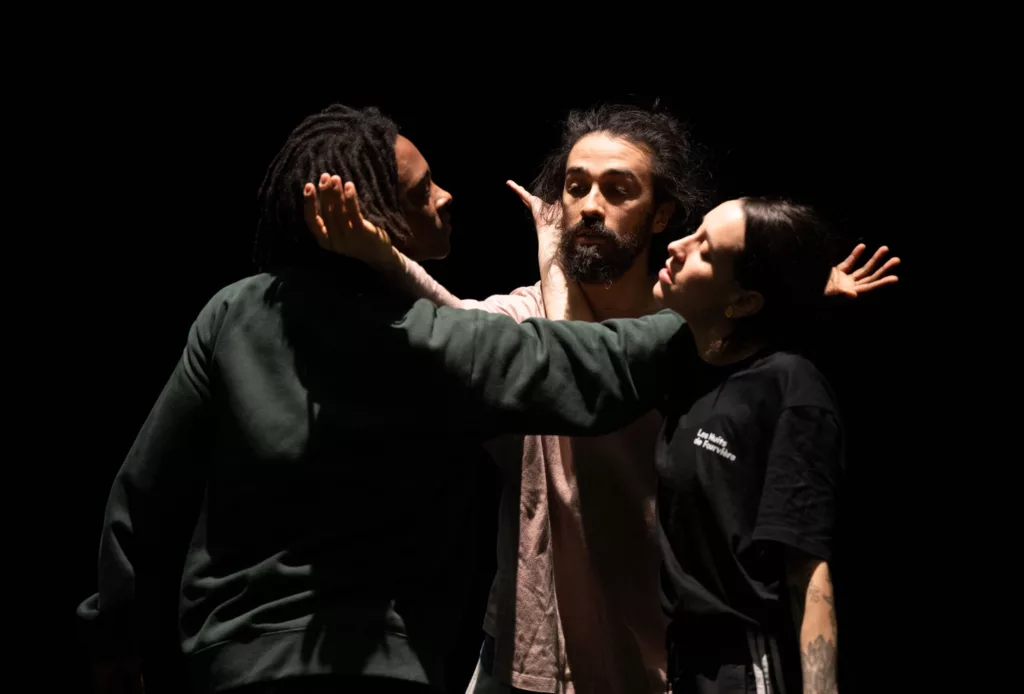
As a child, Mickaël Le Mer played the film Les Uns et les Autres by Claude Lelouch (1981) on repeat. The scene from Ravel’s Bolero has influenced him ever since. The circle then took up space and would become the marker of this new creation.
Widely present in the world of hip-hop, the circle is the essence of breakdancing and freestyle. It materializes in space, it participates in choreographic constructions. The circle is also present in the body, in the movements of the pelvis. It also figures in societal questions: what is the circle in a group? How does it allow us to identify, to assimilate into a group? And how can it also be a danger for our society?
What does the circle tell us when it is open? What does it tell us when it is closed? What happens when a piece is missing from the circle? What is visible? What is invisible? What does it convey about the spiritual order? What place does it have in rituals?
From the full to the semicircle, from the loop to the ellipse, this new creation, in which dance, scenography, light, and music will be all-encompassing, aspires to capture the essence of this symbolic form.
November 8th – 10th, 2024 National Performing Arts Center, Taipei November 15th – 16th, 2024 Rohm Theatre Kyoto, Kyoto November 20th, 2024 The Museum of Art Kochi, Kochi December 10th, 2024 Theater im Pfalzbau, Ludwigshafen December 18th – 19th, 2024 Auditorio de Tenerife, Santa Cruz de Tenerife January 25th, 2025 Teatro Municipal da Covilhã, Covilhã February 1st – 2nd, 2025 Sadler’s Well, London February 7th – 9th, 2025 Perth Festival, Perth February 26th – 27th, 2025 Le Quartz, Brest March 4th, 2025 Les Quinconces et L’Espal, Le Mans March 6th – 7th, 2025 CCN de Caen, Caen March 10th – 11th, 2025 Théâtre de Cornouaille, Quimper March 14th, 2025 Cndc Angers, Angers March 28th – 29th, 2025 Tanzmainz Festival, Mainz April 2nd – 4th, 2025 La Comédie de Clermont, Clermont-Ferrand April 8th, 2025 Théâtre de Nîmes, Nîmes April 15th, 2025 Espaces Pluriels, Pau April 30th – May 3rd, 2025 Danse Danse, Montreal May 16th, 2025 Theatro Circo, Braga July 8th – 9th, 2025 Colours International Dance Festival, Stuttgart 75 minutes
Collective identities are sources of belonging and inclusion but when they become mainstream, they can turn the other way around. I can recognise this issue in dance.
In CARCAÇA, ten dancers including Marco da Silva Ferreira and two musicians form an unconventional and joyful corps de ballet. The dancers perform intricate footwork merging folk dances with contemporary urban dance styles from groups such as LGBTQIA+ and communities from ex-colonies. In this choreography, Marco da Silva Ferreira uses dance to investigate communities, the construction of collective identity, memory and cultural crystallization. In other words: what if folk dances had not crystallized, had continued to redefine themselves and had incorporated the present at every moment?
The cast explores their collective identity in a physical, intuitive and unpretentious flow of the body, dance and cultural construction. They start from familiar footwork: clubbing, balls, cypher battles and the studio; they use the physical vocabulary of the contemporary, social, urban context as a lexicon of identity (house, kuduro, Top Rock, hardStyle, etc.). Through a slow construction process they connect these styles with the heritage and memory of dances from the past. These folk dances have remained stagnant without integrating new definitions of bodies, groups and communities, which were considered inferior. For these groups it was necessary to break with the authoritarian, totalitarian and paternalistic past.
In CARCAÇA an exercise is proposed that integrates the past and the present. The performance makes you think: How do you decide what to forget and what to remember? What is the role of individual identities in the construction of a community? What is the driving force of an identity? What world does the individual and collective body traverse? Or, better put, what bodies traverse the world?