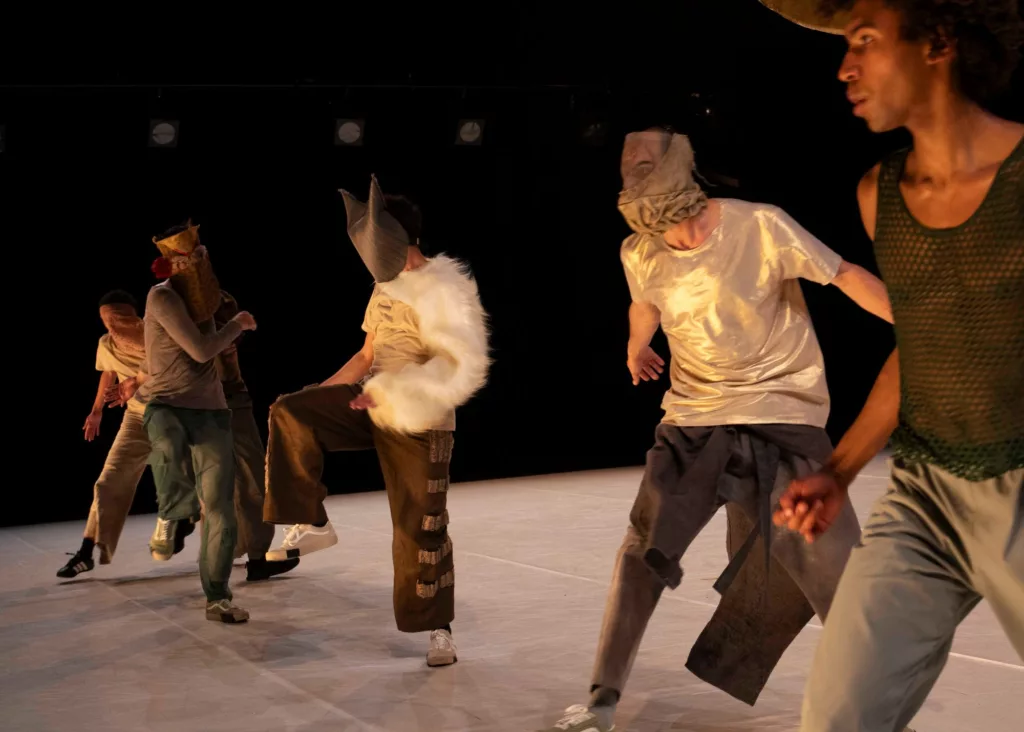
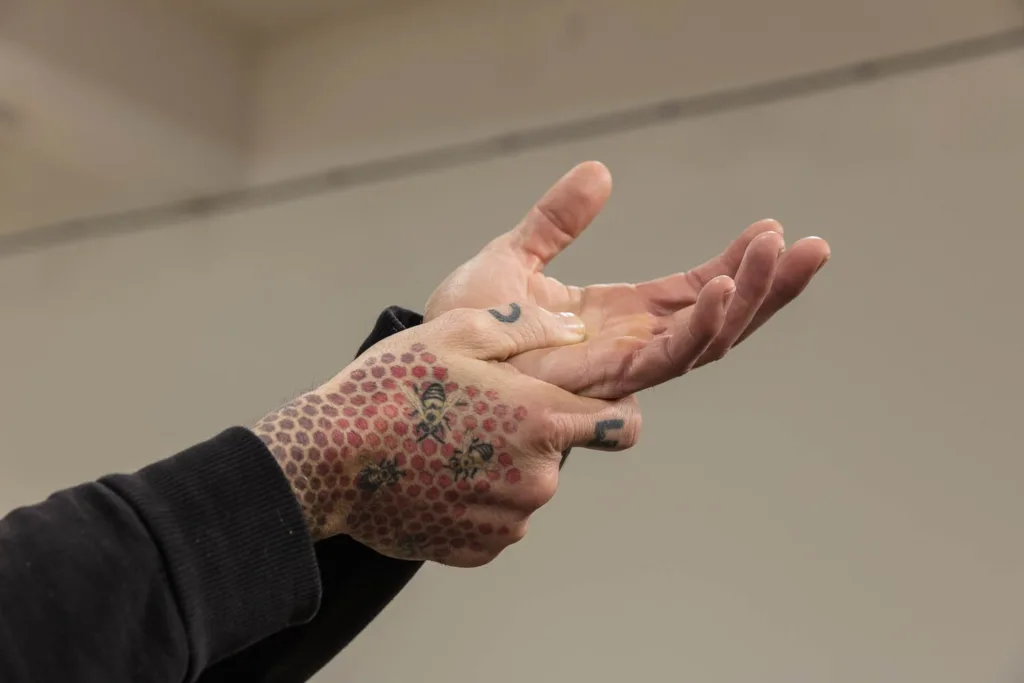
Magec / the Desert is the second part of a new trilogy by Radouan Mriziga, inspired by mythological stories from the Amazigh culture, and in particular those who have a close relationship with the Atlas Mountains in North Africa, in terms of spirituality, art, philosophy, craft, and science.
In his work, Mriziga continues his practice of collective creation, where rhythm, text, movement, and sound become interwoven through the contributions of his collaborators. The choreography unfolds as a polyphony of perspectives, where individual experiences intersect to form a shared, multifaceted vision. Like the layered textures of the desert, the performance resists singularity, instead offering a complexity that is at once intellectual and deeply sensory.
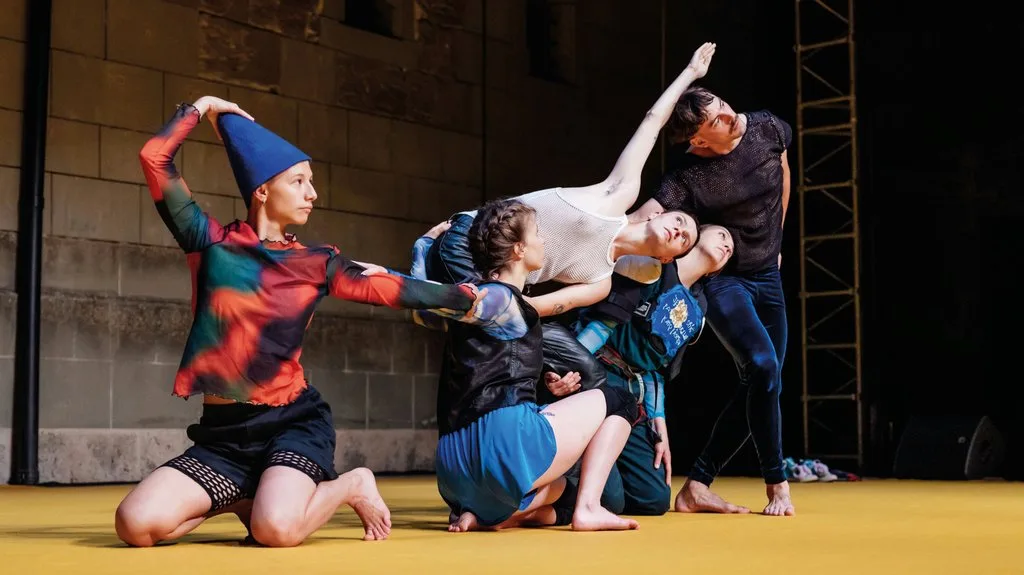
In Medieval Crack, Collectif Foulles, accompanied by historian Clovis Maillet, goes in search of the queer cracks in medieval history — those hidden spaces that allow other narratives, identities, and dances to emerge. In a bid to reappropriate time and history, the collective gleans material for emancipation from the representations and relics of the Middle Ages. Yes, the medieval period also had its happy hours of enlightenment and freedom.
The collective questions the shifts in meaning inherent in the mapping of our bodies — both past and present. All of this is captured with great mischief in a living fresco full of relief and gaiety.
Collectif Foulles—made up of Collin Cabanis, Auguste de Boursetty, Délia Krayenbühl, Emma Saba, and Fabio Zoppelli—has existed since 2018. It all started with affinities, friendships, jokes, and a meeting.
A desire to dance together, to share music, images, and texts—to share a host of things with a host of people. In their work, their most diverse passions come together in a jumble, with no hierarchy. Their approach is precise and respectful, but also celebratory and generous. They weave threads of discussion and tension, maintaining complexity—crossing time with the joy of a battalion.
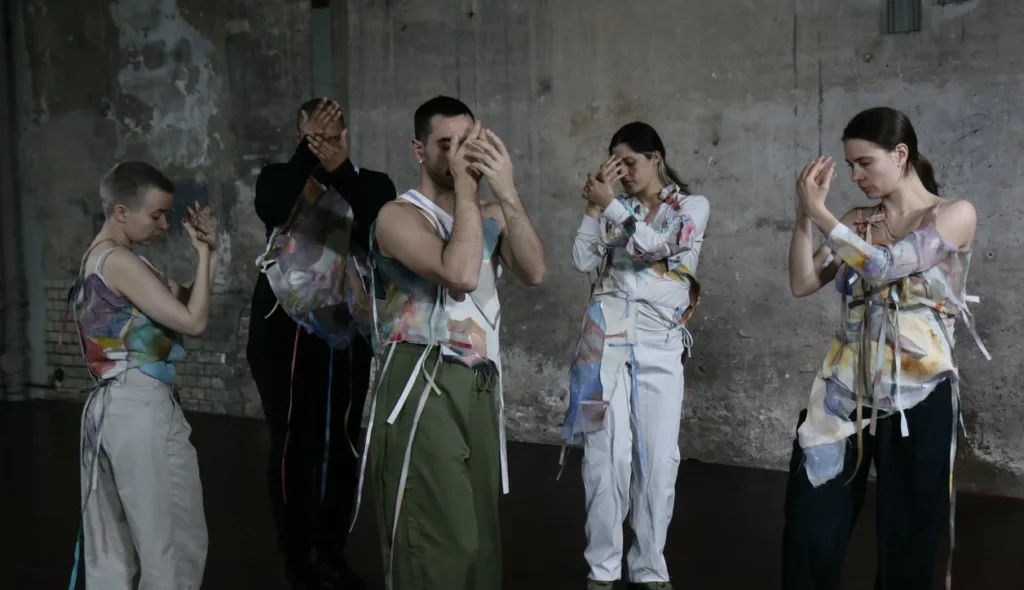
Shiraz is a choreography for six dancers, weaving together a fabric of movements and gestures. Their insistent energy, moments of convergence and passage through ephemeral constellations are what takes center stage in this performance. A pulsating dance imbued with a sense of enchantment and longing, coiling and uncoiling to the pulsating beat of a capturing music.
The starting point for this piece is the Shiraz Arts Festival. A festival for live arts that took place between 1967 and 1977 in south of Iran and radically rethought the relationship to the audience and modalities of framing art works. Armin Hokmi, together with the team, places it into our present day in the form of a revival, by giving it a new appearance through a dance performance. Shiraz is both a homage and a fictional setting. It seeks to reimagine the ambitions of the festival and its love for the live arts, their autonomy as art forms and their common roots across geographical borders.
Shiraz is created out of a devotion to a notion of dance and choreography that emphasizes their power to ignite joy, bring about experiences of delving into sensuous worlds, and their ability to transform perception and our modes of affective engagement with live performance.
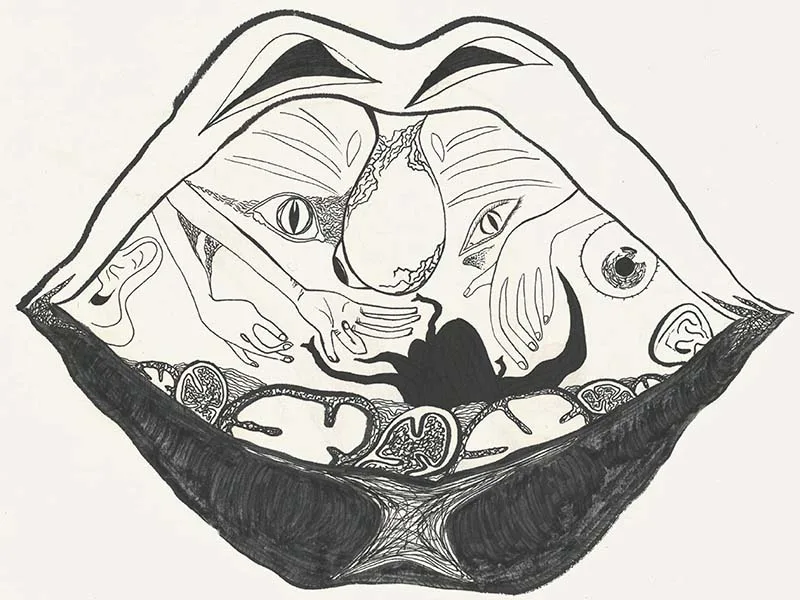
The analysis of myths has always been approached from a patriarchal, xenophobic perspective, rife with slut-shaming, perpetuating the illusion of a single possible interpretation for each story–glorifying the ‘good’ and ostracizing the ‘bad.’ It is urgent for me to question the myth of Medusa and the prevailing injustice toward this mistreated figure, who was ultimately abandoned by society, strikes me profoundly today. As Abir Alsahlani said, “with the current political climate of blatant hypocrisy and humanity failing again and again, it seems necessary to retell the stories that have been swept under the rug of conservatism, neutrality, silence, and complicity.”
This dance was supposed to be a trio. After the death of my trans sister and best friend, Teresa Ves Liberta, this piece is conceived as a gift for her and for all the magic and strength she brought into being.” — Oscar M. Damianaki
In his artistic practice, Alex Baczyński-Jenkins explores affects, queer sensuality, the collective and the suspension of time. He comes back to Arsenic with a new group performance dedicated to the finitude. Whether it’s through a grand finale, the erotic erasing of the limits, or through ecstatic surrender. The final result is an intense dance looking for an expression of the intensities of the end, of the endings. In the end, the result is almost tactile, raw and minimal.
The artist, co-founder and member of the queer feminist collective Kem, laureate to the prestigious Frieze Artist Award in 2018, offers here, once more, a piece of rare and radical beauty.
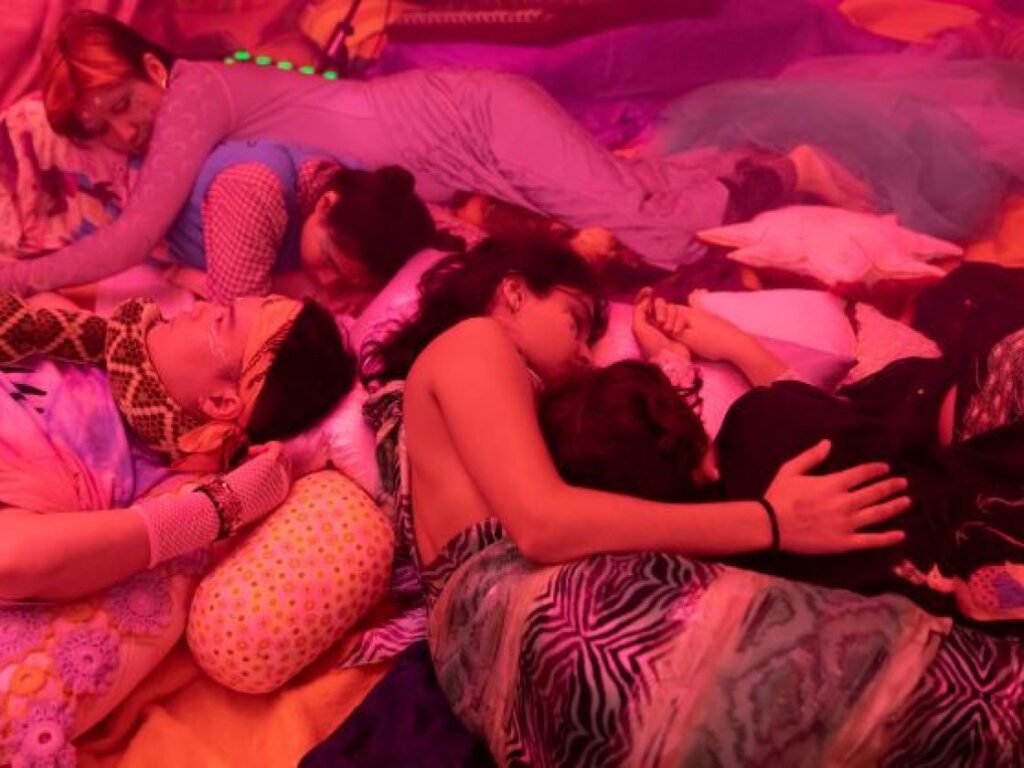
In the upcoming edition of the PARIYESTAN-multiverse – a series of durational collective dream meditations – we will focus on slow, dreamy choreography accompanied by recitations of traditional persian poetry and classical live music, this time specifically around the topics of sisterhood and motherland. sisterhood is embraced in the form of resistance. a gathering of sisters dreaming together in languages they don’t understand. they share artistic expressions freely while creating a monument in time together. through slowness, love and trust, they are powerfully exploring other possibilities of co-existing.
Parisa Madani // PSORIASIS (RIP) aka B1txx3$k?llah*fka the Persian Princis from the Gorgeous House of Gucci and the Iconic Hall of Fame Kiki House of Juicy Couture بھ پاریستان خوش آمدید Pillow Talk say ha name – the story of a long-nailed german-iranian woman of trans* experience with sharp green eyes working with live arts and the communities. In the last four years, the collective has released live and digital art on their website, a mini album (pariyestan on soundcloud). it has also started the multiverse of collective dream meditations through collaborations with international artists and shown in the Netherlands, Germany, Portugal and Italy.
Inspired by ancient persian mythologies and spiritualities, the immersive performances create spaces of worship and resistance; especially for those of non-white, neurotypical, queer & trans communities and others who are underserved by traditional and conservative legislations. In the future she might lead a spiritual revolution, tour the world as a secret popstar with big tits and/or meditate inside volcanoes until the end of time.
September 25th – 29th, 2024 Théâtre du Rond-Point, Paris October 3rd – 4th, 2024 HAU – Hebbel am Ufer, Berlin October 19th – 20th, 2024 Staatstheater Mainz, Mainz October 31st – November 2nd, 2024 VIDY, Lausanne November 5th, 2024 L’onde – Théâtre et Center d’Art, Vélizy November 12th, 2024 teatr polski (Festival Prapremier), Bydgoszcz November 21st, 2024 Temporada Alta, Girona March 19th – 23rd, 2025 dansa metropolitana, Barcelona March 26th – 29th, 2025 Les Célestins, Lyon May 16th – 17th, 2025 FITEI, Porto May 24th, 2025 Spring Performing Arts Festival, Utrecht May 29th, 2025 Mittenmang Festival, Bremen June 4th – 7th, 2025 Rising Festival, Melbourne 90 minutes
Bringing together Bach and Miley Cyrus, she creates with “Kill Me” a complete and radical work, sometimes unsettling, sometimes subversive, but always impactful.
Olivier Frégaville-Gratian d’Amore
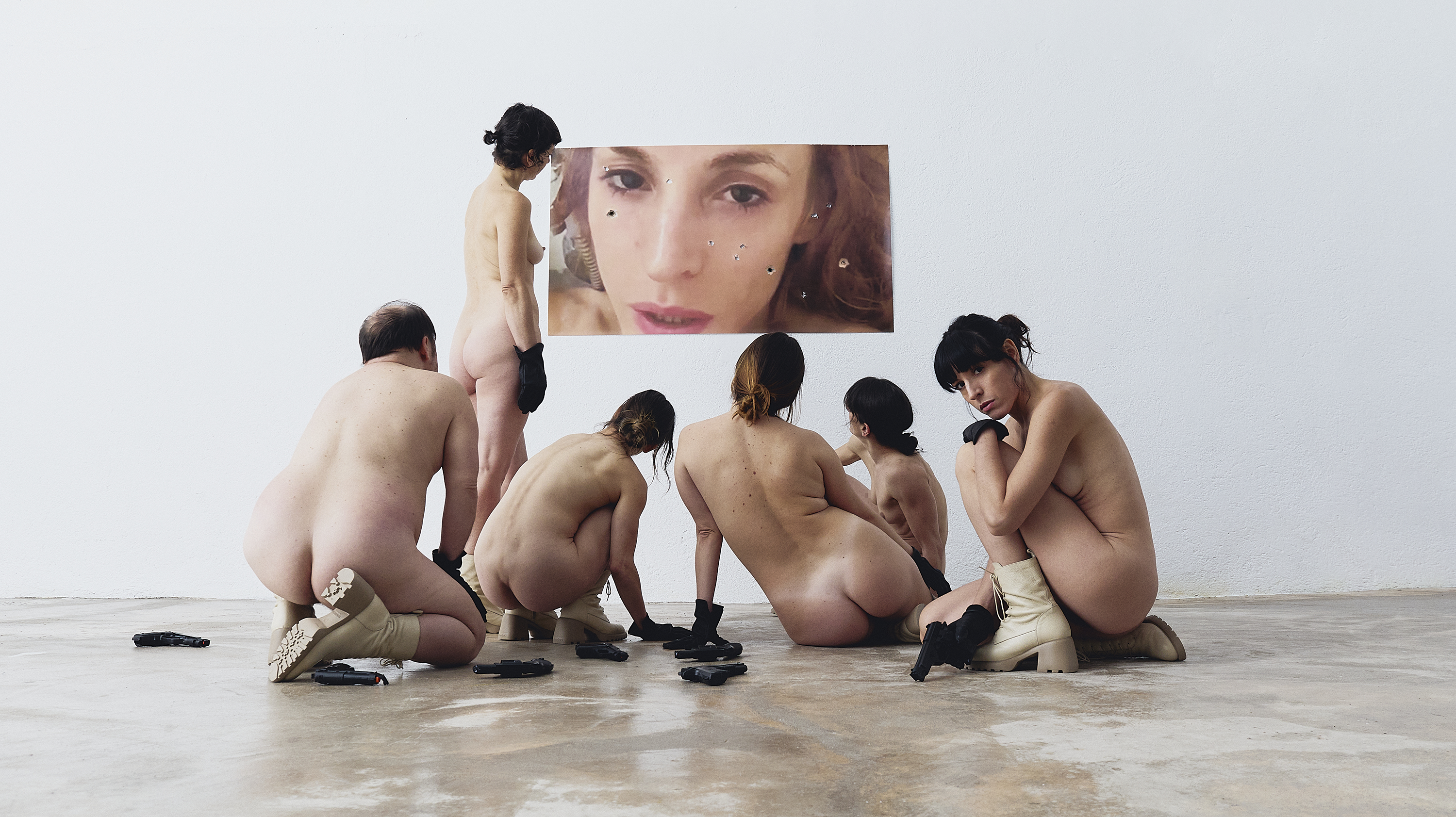
Kill me (2024) is the continuation of Love me (2022) and Fuck me (2020), in turn it is part of the project “ Remember to live ”, in which I intend to present different versions of works until the day of my death.
Entering into the cliché of the midlife crisis, I began to film everything I did: with my heart open 24 hours a day, I recorded everything.
Until one day I collapsed, I was given a psychiatric diagnosis and I decided to make my next piece out of it. I called on four dancers with mental disorders and Nijinsky, to make a piece that talks about madness for love.
But let’s say that the topic is about mental health so that it enters the inclusive agenda of the art market.
Because that is my punishment, having to make works that sell and thus stay alive in the world (of theater).
September 20th – 22nd, 2024 HAU Hebbel am Ufer, Berlin October 4th – 6th, 2024 Esplanade, Singapore October 11th – 12th, 2024 Tanzquartier Wien, Vienna March 7th – 9th, 2025 Kampnagel, Hamburg March 14th – 16th, 2025 Arsenic, Lausanne March 20th – 21st, 2025 Maillon, Strasbourg March 25th – 26th, 2025 Points Communs, Cergy March 29th, 2025 La Briqueterie, Vitry-sur-Seine May 3rd – 4th, 2025 Festival DDD, Porto May 22nd – 23rd, 2025 Spring Performing Arts Festival, Utrecht June 21st – 22nd, 2025 Festival Theaterformen, Hannover June 29th, 2025 Belluard Bollwerk Festival, Fribourg July 4th – 6th, 2025 National Arts Festival, Makhanda July 12th – 13th, 2025 Santarcangelo Festival, Santarcangelo di Romagna 80 minutes
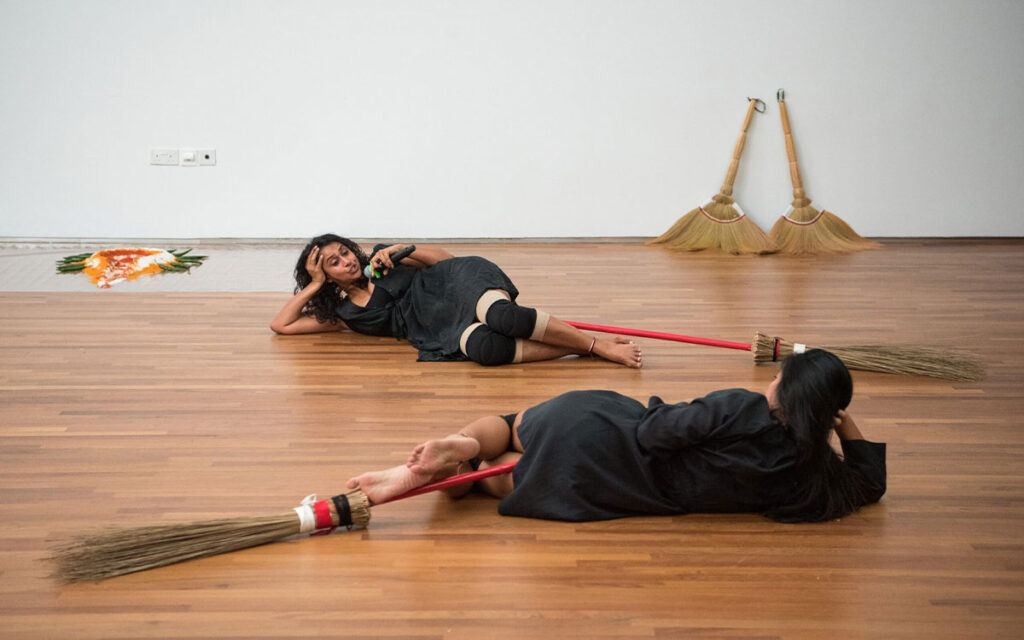
Interweaving ritual, pageantry, performance and possession, Magic Maids presents an encounter with two figures engaged in the ritual act of sweeping. The broom, a domestic tool for cleaning and the vehicle of the witch, becomes a symbol of both oppression and resistance. It is an extension of the body and a portal for metamorphosis. The art workers and their brooms exist in a continuous state of becoming.
Eisa Jocson and Venuri Perera are from the Philippines and Sri Lanka respectively, two countries known for their significant export of domestic workers. Their collaboration began in 2022 when they noticed the absence of women at Basel Museum of Pharmaceutical History in Switzerland. This observation sparked their investigation of the historical persecution of witches; in Europe and its implications for the exploitation of female labour in colonised regions. They discovered that the accusation of witchcraft continues to be a tool for persecuting migrant workers from the Global South.
Magic Maids is a bodily response to their grappling with these complex entanglements. They call upon practices of incantation and intention, using their bodies to traverse multiple territories: physical, conceptual, transnational, emotional, and gendered. The labour in performance enables an embodied inquiry into questions of representation, political subjecthood and histories of oppression. Having individually presented solo work across international festivals and platforms that follows this line of inquiry, Jocson and Perera come together for the first time to sweep out and unsettle oppressive power structures. Rewilding the domestic, they aim to release, reclaim, rejoice, and reconnect with the primal energies.
Magic Maids is an invitation to witness and reflect on the visibility of the working body, the power of female solidarity, and the enduring impact of historical injustices on modern labour practices.