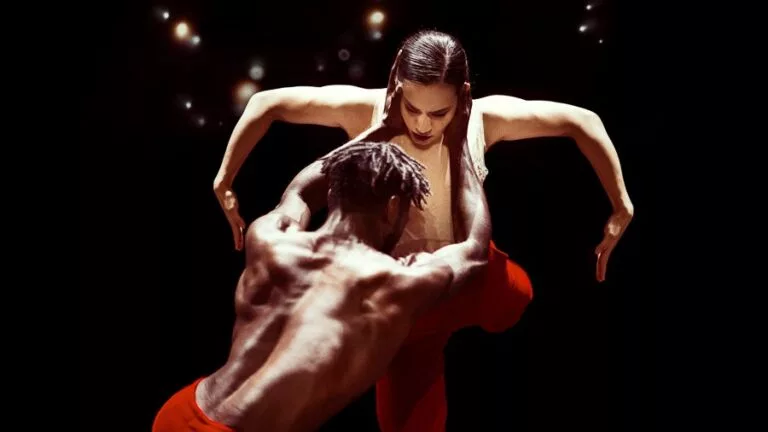
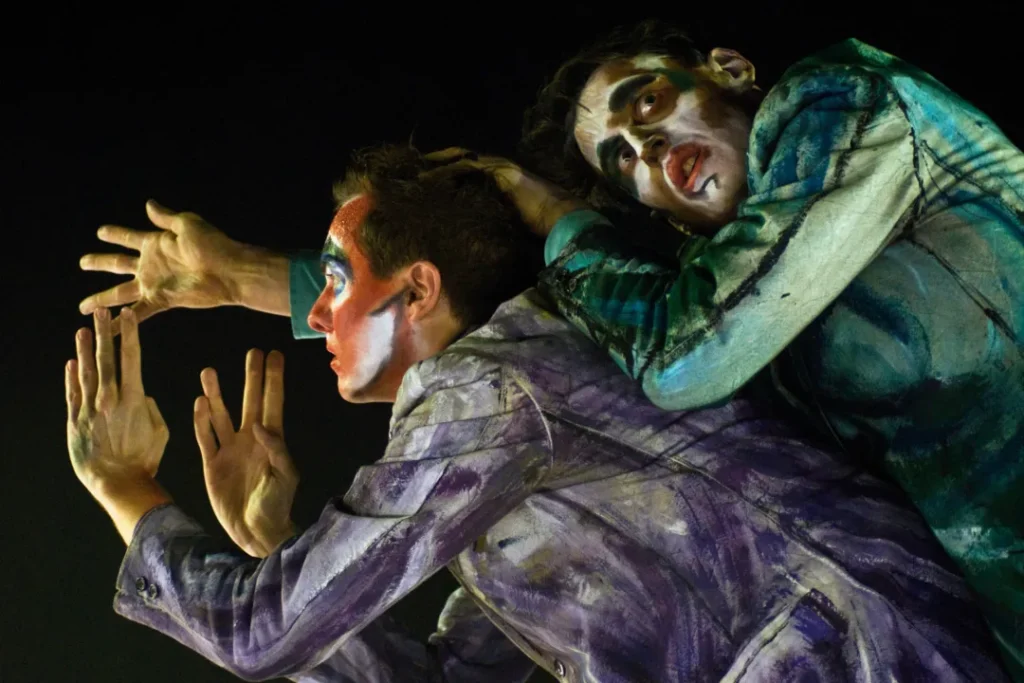
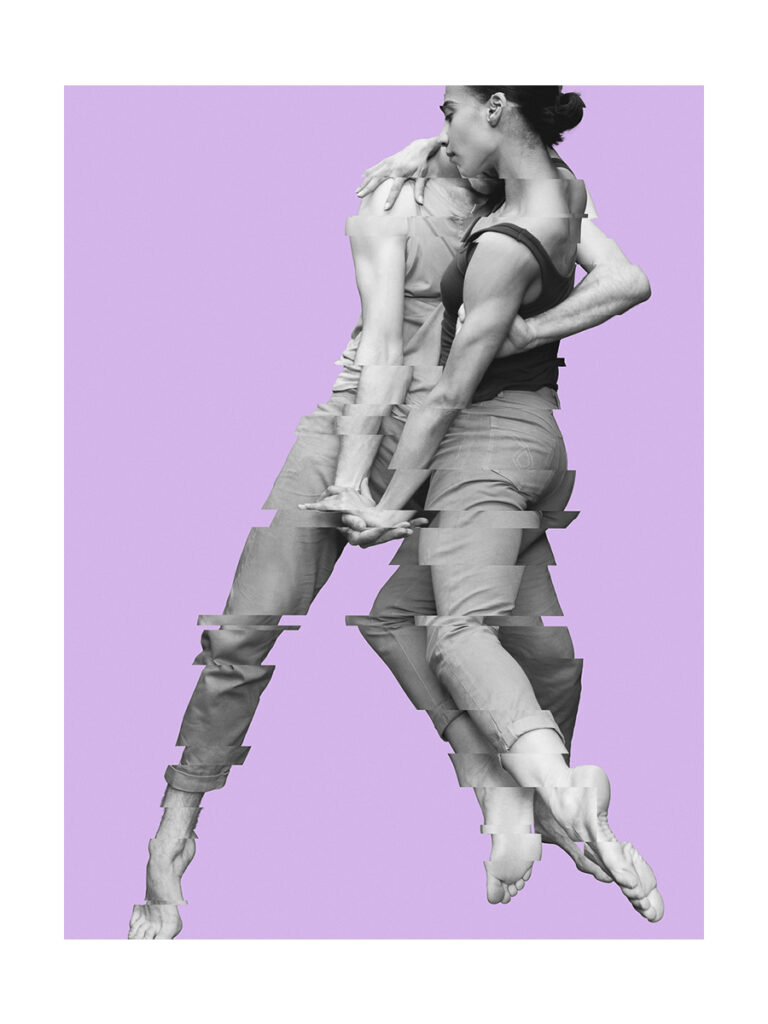
On October 10 and 11 you can watch RESONANCE, the first NDT 1 programme of the season, as a livestream from the comfort of your living room. Experience Jiří Kylián’s Mémoires d’Oubliettes (2009) up close, find yourself right in the middle of Crystal Pite’s satirical boardroom drama The Statement (2016), and be moved by Marco Goecke’s emotional Woke up Blind (2016), set to the music of Jeff Buckley.
June 11th – 13rd, 2025 Holland Festival, Amsterdam June 15th – 17th, 2025 Holland Festival, Video on Demand December 13th, 2025 Concertgebouw Brugge, Bruges 70 minutes
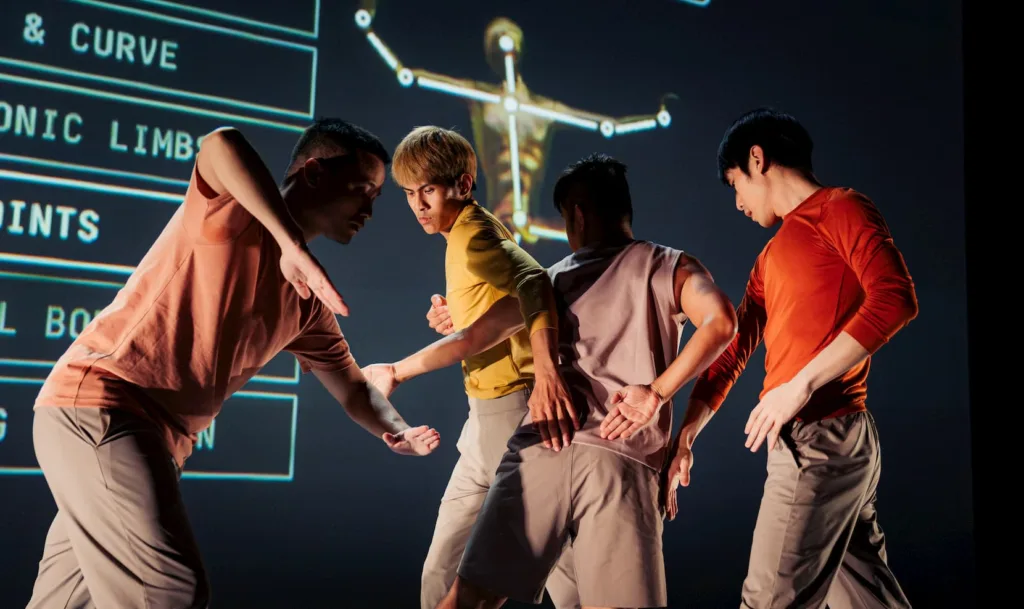
The opening performance of the Holland Festival 2025 is Cyber Subin, which will also mark its European premiere. In Cyber Subin, choreographer Pichet Klunchun (Thailand, 1971) combines traditional Thai dance with technology. Together with MIT researcher Pat Pataranutaporn, he has created an AI that deconstructs traditional movements and generates new poses, resulting in a fascinating interaction between human and machine.
The movements of both the people and avatars in Cyber Subin are based on “Mae Bot Yai” (59 poses from a traditional Thai masked dance, Khon) but will be reinterpreted through digital processes. The dancers are invited to react, resist or dance together with the avatars.
For more than two decades, Klunchun has studied the movements of Kohn dance, looking for ways to reinterpret these. He developed Cyber Subin in four phases: capturing the movements, codifying them according to six principles, developing an interface for interaction with avatars, and experimenting with dancers and AI.
Khon has been performed since the 14th century and was added to the UNESCO list of Intangible Cultural Heritage of Humanity in 2018. As such, the piece is not just about the interaction between human and machine, but also offers a new approach to cultural preservation. Cyber (derived from cybernetics) Subin (‘dream’ in Thai) shows how tradition need not be static, but rather lives and evolves.
Afanador emerges from the tension between the fascination that emanates from Ruven Afanador’s photos, and my own fascination with all the mystery, so diurnal and yet so nocturnal, that once fascinated Ruven.
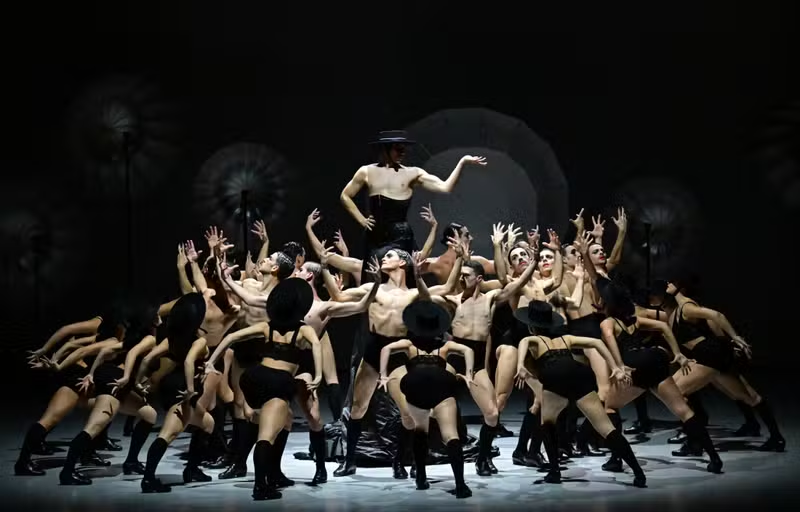
Marcos Morau
Ruven Afanador’s photography is not documentary or monumental—it doesn’t archive history or glorify its subjects. Instead, it is driven by desire, distorting and being distorted by its object. Desire, elusive by nature, shapes what it sees, revealing subjective and profound truths.
Afanador approaches Andalusian folklore through this lens, exposing flamenco’s raw subconscious—its passion, death, and untold stories. His work amplifies its essence into a surreal, evocative world of shadow and light, where he both observes and is observed.
Our work extends this vision, capturing Afanador’s gaze and the transformative power of photography. Like Goya’s Caprichos, these images blend familiar themes through association and metamorphosis, turning photography into both miracle and mystery. Each shot lingers just beyond reach, on the verge of vanishing into its own fire.
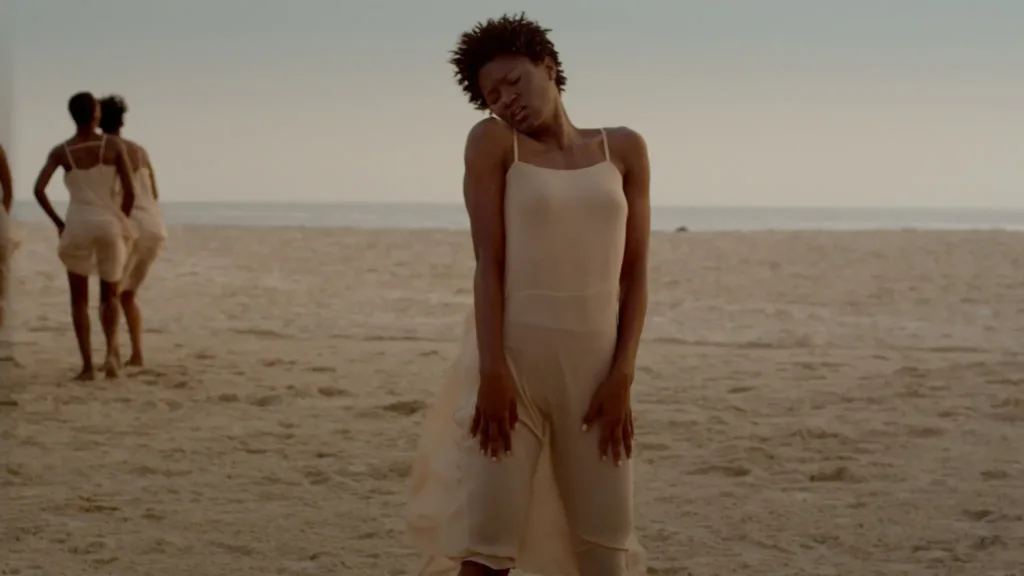
In this stunning film, Pina Bausch’s iconic choreography The Rite of Spring is danced in an extraordinary setting, on the beach in Toubab Dialaw, Senegal.
Filmed in 2020 as the world descended into lockdown, it captures the last rehearsal of a specially assembled company of 38 dancers from 14 African countries and documents a unique moment in their preparations for an international tour. A rare opportunity to watch one of the world’s greatest dance works.
Dancing at Dusk was first shown on Sadler’s Wells Digital Stage in July 2020. That year Pina Bausch’s 1975 seminal work, The Rite of Spring, was due to tour the world. Performed by a specially assembled company of 38 dancers from 14 African countries, this international co-production between Sadler’s Wells (UK), Pina Bausch Foundation (Germany), and École des Sables (Senegal), should have opened in March 2020 in Dakar as part of a double-bill with a new work created and performed by Malou Airaudo and Germaine Acogny, common ground[s]. However, just days before the premiere, performances were cancelled as governments around the world banned public gatherings and began shutting their borders due to the Coronavirus pandemic.
Before disbanding and going into lockdown, the company seized the moment by performing a last rehearsal on a beach near their base at École des Sables in Senegal. Filmmaker Florian Heinzen-Ziob and his crew were able to capture this unique moment in a stunning film.
Many years ago, when leafing through the books in the Arnolfini bookshop, choreographer Lea Anderson discovered the work of Austrian expressionist painter, Egon Schiele. Lea was taken by the possibility of seeing Schiele’s framing of the repeated figures in the reproduction of his sketchbooks, as a system for writing dance. What resulted from this intrigue was a full misconstruction of dances, imagining Schiele as a choreographer whose dances had been lost.
Originally created in 1998 as a live work, it was remade as a film in 2010 in collaboration with Deborah May of Kinoki and with new music by Steve Blake and Will Saunders. The film has never been publicly aired and will be a world premiere for Dance Umbrella 2024.
Lea Anderson is a celebrated dance choreographer, filmmaker and artistic director. Her iconic dance company The Cholmondeleysis celebrating its 40th anniversary this year and its brother company, The Featherstonehaughs is not far behind. Lea makes groundbreaking theatre work and films, was awarded an MBE in 2002 and was given an honorary doctorate of arts from Dartington College of Arts in 2006.
Christos Papadopoulos’ new work explores our subtle, everyday social connections, revealing the beauty within the most profound connections that often go unnoticed. Drawing from the unadorned fabric of the human experience, the choreographer illustrates the simplicity of shared moments: the unspoken understanding between friends, silent nods of solidarity among strangers, and the quiet resilience threaded through collective struggles.
A new voice for NDT, the Greek-born choreographer favours a minimalist and precise language of movement. Through small gestures that belie an intense physicality, Papadopoulos has created an ode to the power of invisible forces and transports the audience to a mysterious space in which there is neither beginning nor end.