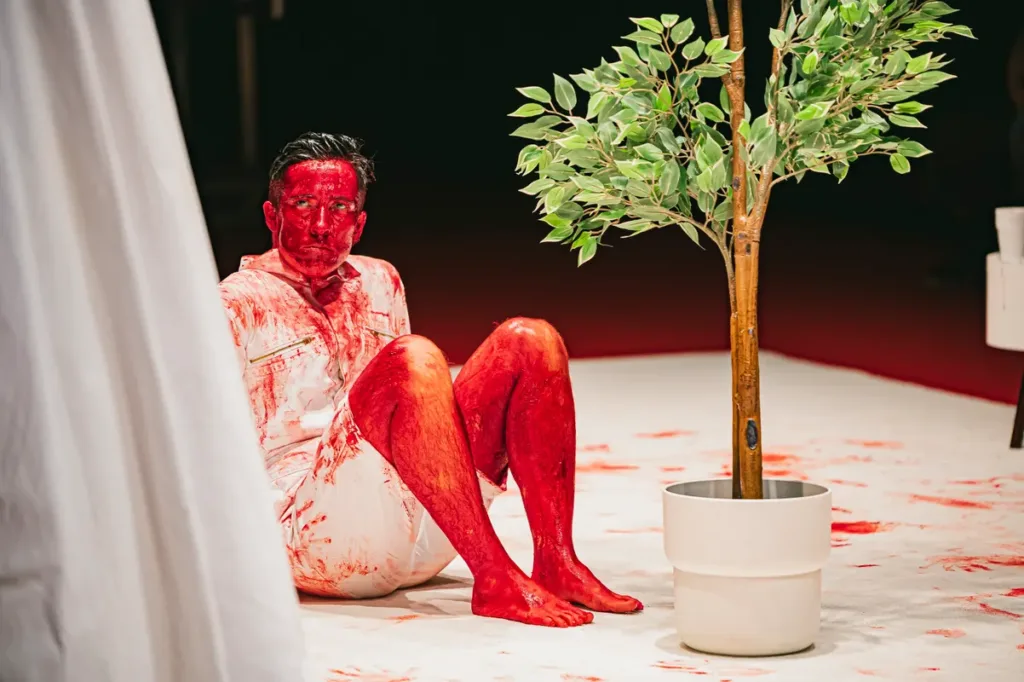
Three figures, 75 liters of fake blood, an endless battle – Blood Show is a call to put what’s inside on the outside and defend oneself against violent gazes. This cyclical feat of endurance and precision is a euphoric trans celebration of destruction – including our own – in order to create something new. Questions revolve around the concept of rebirth and the ghosts we carry with us. Blood Show is the second performance in Ocean Stefan’s “Extinction” trilogy – an experiment to reflect on the limits of the human body. Why do we want to know what people “really” look like? How dangerous is the idea of the “natural”?
Ocean Stefan makes work with runs across performance, installations, texts and film. Their artistic practice moves in the in-between and in superimposition – it celebrates the living and the blurred. Ocean Stefan is interested in the gray areas of life and questions the fixed.
June 2nd – 3rd, 2025 HAU, Berlin June 11th, 2025 Les Rencontres à l’Échelle, Marseille June 24th – 25th, 2025 Festival Theaterformen, Hannover July 5th – 8th, 2025 Festival d’Avignon, Avignon December 9th – 11th, 2025 Les Tanneurs, Brussels 70 minutes
The internationally acclaimed dancer and choreographer Ali Chahrour has created a language inspired by Arab myths and by the political, social, and religious context of his country. Through it, he explores the deep relationships between the body and movement, between tradition and modernity.
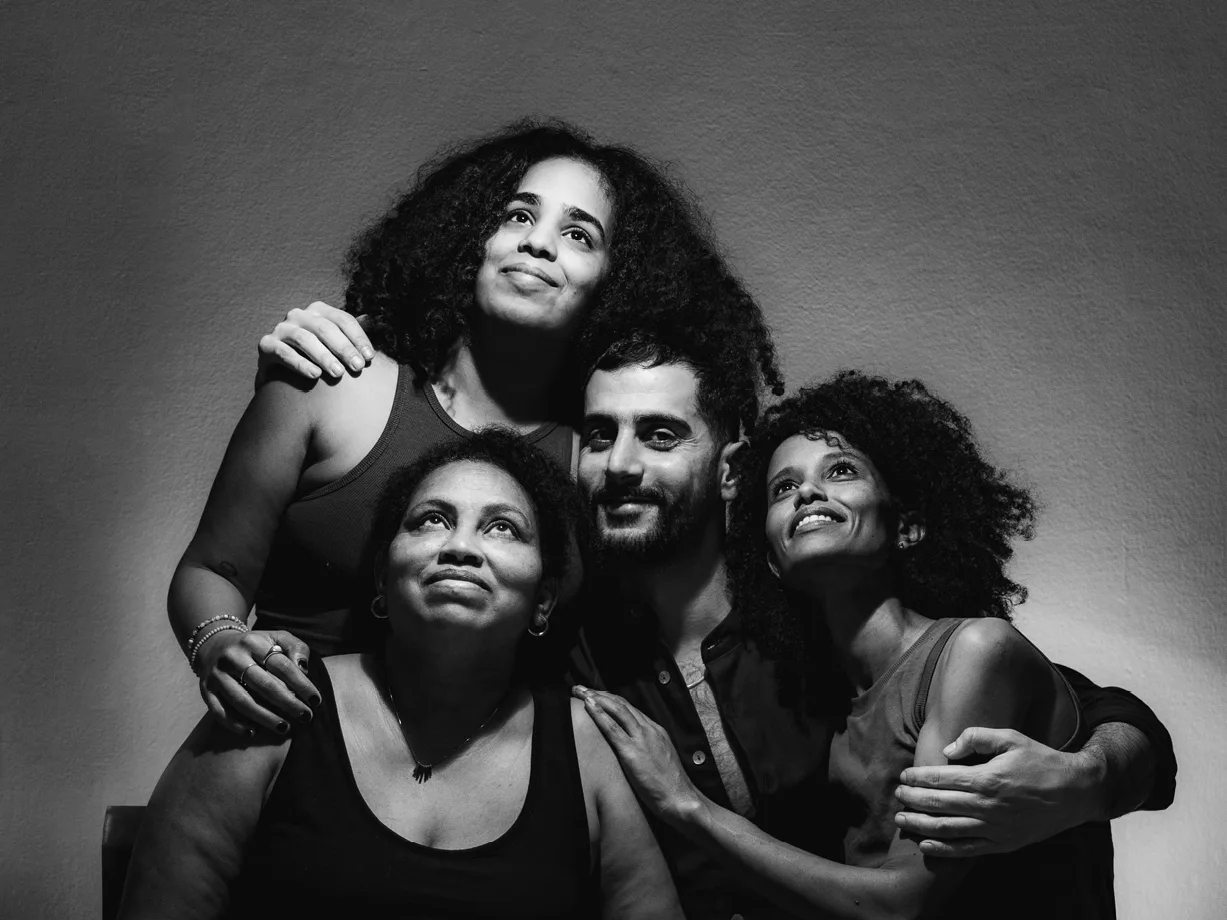
His new work When I Saw the Sea unfolds on a minimalist stage: the activists Rania, Zena and Tenei – the last two came to Lebanon as migrant workers – embark on a powerful journey of their previously unheard stories through dance, theatre and music. In doing so, they give a voice to countless other labourers from countries such as Cameroon, Sudan and Sierra Leone – people who have been deprived of their rights by the kafala system, which is similar to serfdom – and thus create a deep insight into the political and social reality of Lebanon.
When I saw the Sea highlights the abuses of this repressive labour system while paying tribute to the courage and resistance of women fighting for justice and freedom. With a mixture of personal and collective testimonies, the work touches on themes such as love, motherhood, war, exile and home. With the music of Abed Kobeissy and the soulful voice of singer Lynn Adib, this is a determined celebration of life, rising above the pain of past struggles.
September 20th – 22nd, 2024 HAU Hebbel am Ufer, Berlin October 4th – 6th, 2024 Esplanade, Singapore October 11th – 12th, 2024 Tanzquartier Wien, Vienna March 7th – 9th, 2025 Kampnagel, Hamburg March 14th – 16th, 2025 Arsenic, Lausanne March 20th – 21st, 2025 Maillon, Strasbourg March 25th – 26th, 2025 Points Communs, Cergy March 29th, 2025 La Briqueterie, Vitry-sur-Seine May 3rd – 4th, 2025 Festival DDD, Porto May 22nd – 23rd, 2025 Spring Performing Arts Festival, Utrecht June 21st – 22nd, 2025 Festival Theaterformen, Hannover June 29th, 2025 Belluard Bollwerk Festival, Fribourg July 4th – 6th, 2025 National Arts Festival, Makhanda July 12th – 13th, 2025 Santarcangelo Festival, Santarcangelo di Romagna 80 minutes
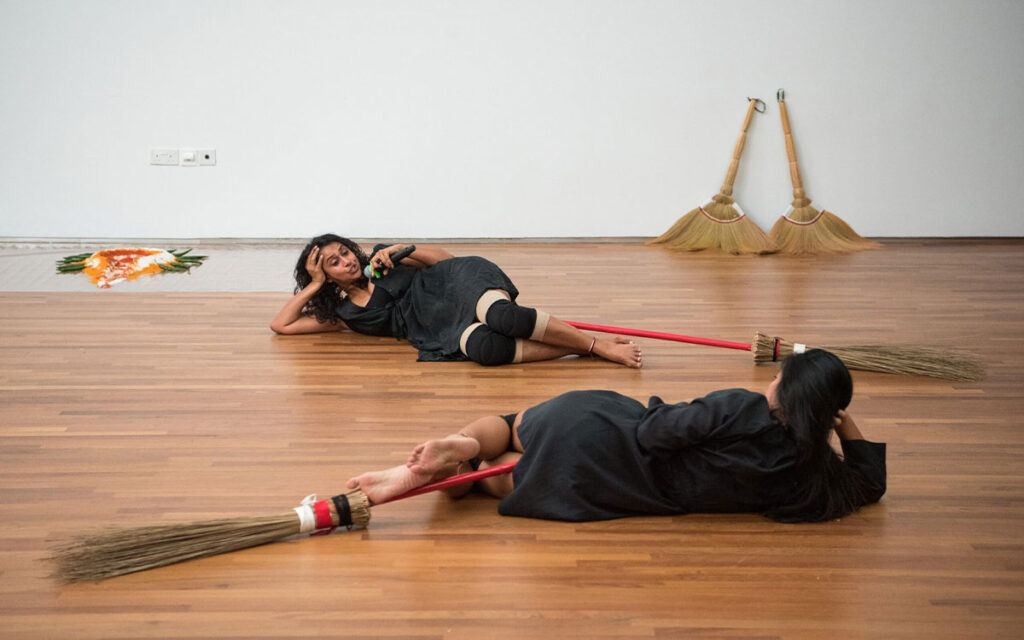
Interweaving ritual, pageantry, performance and possession, Magic Maids presents an encounter with two figures engaged in the ritual act of sweeping. The broom, a domestic tool for cleaning and the vehicle of the witch, becomes a symbol of both oppression and resistance. It is an extension of the body and a portal for metamorphosis. The art workers and their brooms exist in a continuous state of becoming.
Eisa Jocson and Venuri Perera are from the Philippines and Sri Lanka respectively, two countries known for their significant export of domestic workers. Their collaboration began in 2022 when they noticed the absence of women at Basel Museum of Pharmaceutical History in Switzerland. This observation sparked their investigation of the historical persecution of witches; in Europe and its implications for the exploitation of female labour in colonised regions. They discovered that the accusation of witchcraft continues to be a tool for persecuting migrant workers from the Global South.
Magic Maids is a bodily response to their grappling with these complex entanglements. They call upon practices of incantation and intention, using their bodies to traverse multiple territories: physical, conceptual, transnational, emotional, and gendered. The labour in performance enables an embodied inquiry into questions of representation, political subjecthood and histories of oppression. Having individually presented solo work across international festivals and platforms that follows this line of inquiry, Jocson and Perera come together for the first time to sweep out and unsettle oppressive power structures. Rewilding the domestic, they aim to release, reclaim, rejoice, and reconnect with the primal energies.
Magic Maids is an invitation to witness and reflect on the visibility of the working body, the power of female solidarity, and the enduring impact of historical injustices on modern labour practices.