Maybe you can’t and shouldn’t try to explain a choreographic work. When asked, “what is the work about?”, the accurate answer would be: “well, I have no idea, we have to wait and see”. The only thing pre-determined when it comes to choreography, the way Emanuel Gat sees and practices it, is the HOW. The WHAT, the WHY, the WHEREOF, are all elements which emerge from the thing as it is happening.
Emanuel Gat’s work with the Dresden Frankfurt Dance Company will engage with two of the Lieder from Gustav Mahler’s song cycle Das Lied von der Erde. Two parts, with Der Einsame im Herbst and the last Lied of the cycle, Der Abschied, frame a third central part that is without music. Completely different every time it is being performed, the work follows principles in which the choreographic future cannot be designed, but has to be discovered by the dancers each time they engage with the work. Welcome, enjoy the experience!
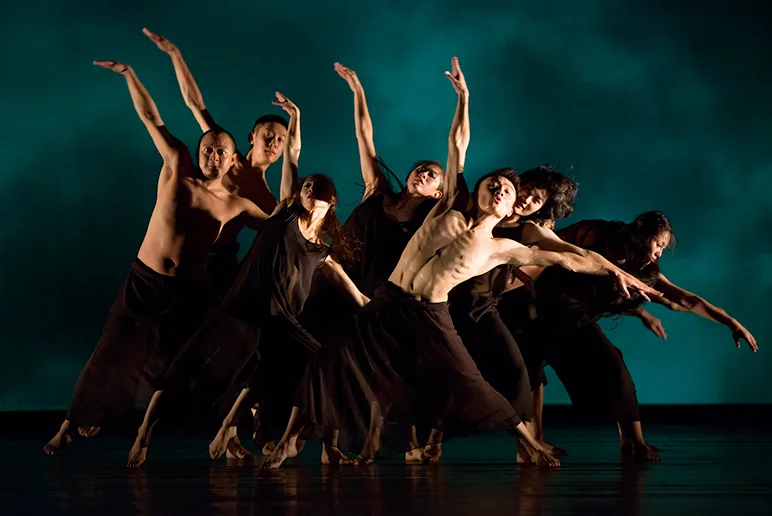
The Jin Xing Dance Theatre was formed in the heart of communist China in 1999 by its founder Jin Xing. At Paris’s Théâtre des Champs-Elysées the company will present four choreographic creations by three choreographers of different origins.
Sacre is revisited version of Emanuel Gat’s 2004 creation. It takes apart the mechanics of Cuban salsa dancing and creates a complex and dramaturgically charged choreographic score. A free spirited reading of Stravinsky’s masterpiece, Sac offers no notions of sacrifice, but a multitude of options for action.
Echo is Moya Michael’s 2013 creation for 7 female dancers with sound arrangement by Anyal Zhang. The focal point of this piece is a group of women, occupying space. Each woman has an individual story intertwining with the group, yet each woman has her own voice. This is not a form of isolation. Recognition is placed on the female gaze and specifically on how change can be experienced through each of their lives. This perspective gives them a greater sense of how they relate to other women and to society as a whole. Their stories echo and their lives reflect similar struggles. They can empower themselves by being true to who they are and by uniting with each other as group. This is a shortened version of the original work.
Cage Birds’ energetic and physically demanding choreography for 12 dancers to Christian Meyer’s hypnotic music. Kuggeleyn uses his trade mark TransDance technique gradually enfold the inner dynamic of the group of performers. Like caged birds the dancers move in their cramped confines. With his creation, Kuggeleyn provides an ironical metaphor of modern life as well as an impressive dance performance.
Wild Flower by Arthur Kuggeleyn
Everyone has a fierce and unique wild flower, which can break free from all kinds of shackles, stand out among the dull, and be graceful within constraints. Known for his emotionally charged psychedelic style, Dutch choreographer Arthur Kuggeleyn created Wild Flower for the company. In it, dancers interpret wild flowers through marathon-esque non-stop dancing and movement, triggering off an explosion of long held emotions.
January 22nd – 23rd, 2025 Opéra Berlioz / Le Corum, Montpellier March 7th – 8th, 2025 Berliner Festspiele, Berlin March 17th – 21st, 2025 Théâtre de la Ville, Paris May 3rd, 2025 Festspielhaus Bregenz, Bregenz 85 minutes
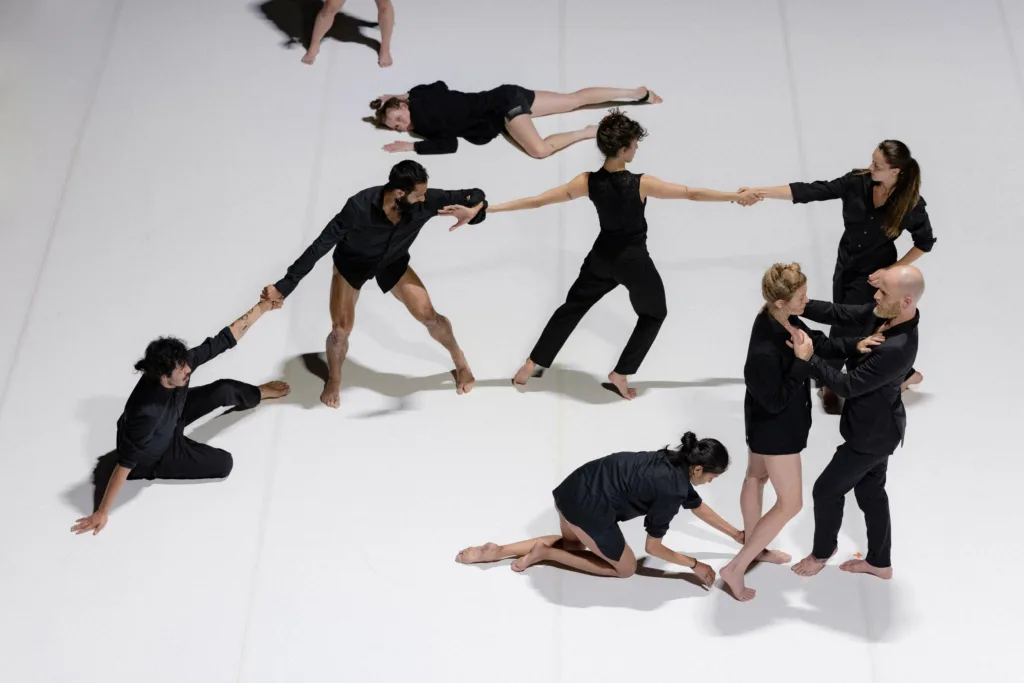
Freedom Sonata is a free, contemporary take on the classic musical sonata form, evolving through three distinct choreographic movements.
The soundtrack is a juxtaposition of two musical sources: Kanye West’s 2016 album The Life Of Pablo and L. V. Beethoven’s second movement from his last sonata #32. Played by Mitsuko Ushida and recorded in 2006.
‘Freedom Sonata’ is yet another chapter in a continuous study into the ways in which groups/individuals behave, function and strive to find a state of balance and fulfillment. It is a manner of looking at the way society organizes itself in different contexts and exploring possible alternative models.
‘Freedom’, the term and concept, is probably the most abused, misused and misunderstood word that exists. The truth is that nothing is easier than stripping people down from any sort of freedom, liberty or natural right. Choreography can serve as a space to examine how to solve the internal tension between the individual and the collective. When asked if my work is political, I answer that my work is not political, but the way in which I work, IS.
If I look at my work from an anthropological angle, as in a process of actively examining questions such as: models for groups organisation, governance modalities and political structures, economic models, resources management and so on, the way I would define it then would be something like:
A commitment, through a choreographic practice, to the idea that it can be possible to have a society based on principles of self organization, voluntary association and mutual aid.
Decentralizing the conventional hierarchies between choreographer and dancers, rethinking the distribution of power and responsibilities, defining what choreography/dance can change the established paradigms by placing individual freedom at the center of dance making, are the most valuable strategies through which dance can become a relevant force in pointing out societal anomalies and proposing alternatives.