Categories
France

Amir Sabra & Ata Khatab – Badke(remix)

  • June 11th – 13th, 2025 KVS, Brussels
  • September 19th, 2025 De Brakke Grond, Amsterdam
  • September 24th – 25th, 2025 VIERNULVIER, Ghent
  • September 26th, 2025 De Spil, Roeselare
  • October 1st, 2025 Concertgebouw Brugge, Bruges
  • October 18th – 19th, 2025 Dream City Festival, Tunis
  • November 11th, 2025 EXPORT/IMPORT FESTIVAL, Brussels
  • November 15th, 2025 Toneelhuis, Antwerp
  • May 19th, 2026 Pole-Sud, Strasbourg
  • May 21st, 2026 Espace 1789, Saint-Ouen
  • May 22nd – 23rd, 2026 MC93, Bobigny

75 minutes

A Different Image of Palestine
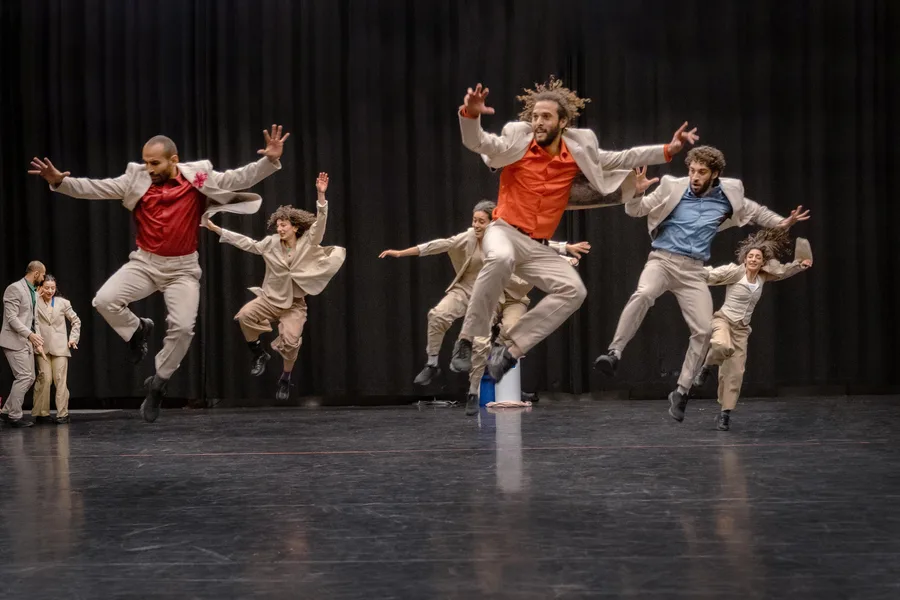
© Kurt Van der Elst

Badke(remix) is a remake of the dance performance created by Koen Augustijnen, Rosalba Torres and Hildegard De Vuyst. With 10 Palestinian dancers, Badke toured worldwide between 2013 and 2016. The reissue of Badke is now artistically in Palestinian hands, namely Amir Sabra and Ata Khatab, and becomes Badke(remix).

The title is a conscious reversal of dabke, the name of the Palestinian folk dance and the starting point of the performance. With backgrounds in traditional dabke, contemporary dance, hip-hop, capoeira or circus, the Palestinian performers bring a contemporary version of this dance traditionally reserved for (wedding) parties. Badke(remix) displays a zest for life and passion for dancing as a form of resistance.
Categories
Archive

Baro d’evel – Qui Som?

September 26th – 28th, 2024 Teatro Argentina, Rome
October 2nd – 4th, 2024 Théâtre 71, Malakoff
October 11th – 12th, 2024 Théâtre de Liège, Liège
October 30th – 31st, 2024 Halles de Schaerbeek, Brussels
November 13th – 15th, 2024 Tandem scène nationale, Douai
December 2nd – 15th, 2024 ThéâtredelaCité, Toulouse
January 10th – 11th, 2025 Le Parvis scène nationale, Tarbes
January 24th – February 1st, 2025 MC93, Bobigny
February 18th – 22th, 2025, Comédie de Genève, Geneva
2h

Part of the 78th Avignon Festival


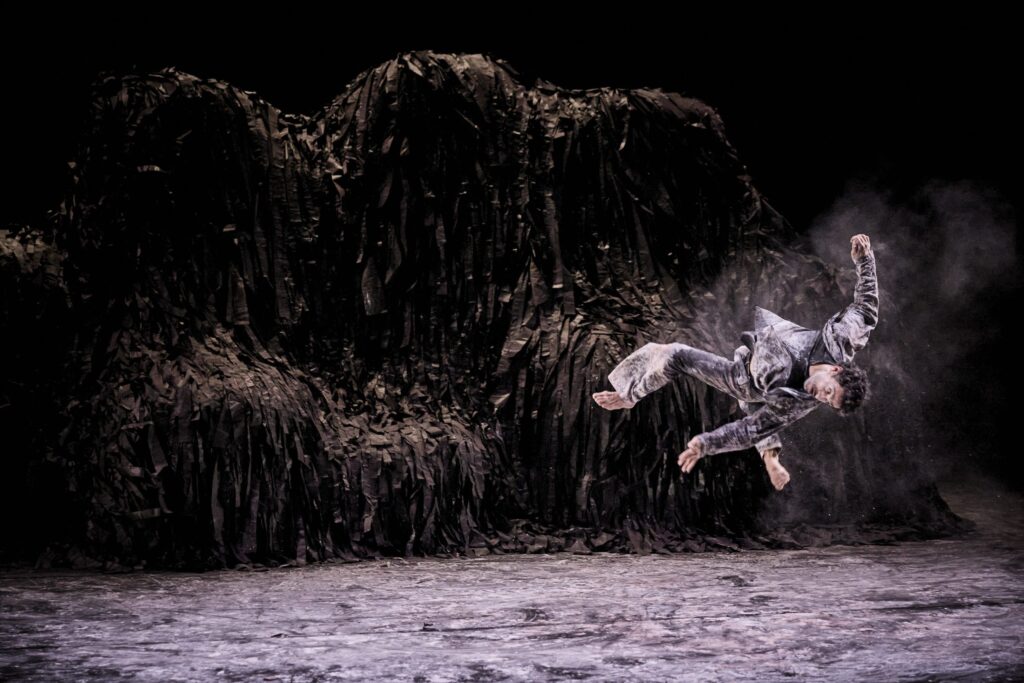
© Christophe Raynaud de Lage

An opus even more choreographic than the previous works, Qui som? , under the influence of the Spanish group Mal Pelo, could be considered the heir to Maguy Marin’s May B or Paso Doble by the duo Josef Nadj and Miquel Barceló.

Philippe Noisette

The first part of a triptych in which ceramic is both the material and the gesture of an investigation into our worlds in the making, a journey through our ways of believing and doing together, Qui som? is a wager: that dreaming is an exploratory and transformative power, an imaginary force that overflows each of us to link us to other presences, a way of orienting ourselves in obscure journeys, in secret lands. It’s a struggle. It’s alive. In colour. In clay. In plastic. In scraps and eternity.

“Our inner worlds, our intimate territories, are the breeding ground for the social landscapes to come. So if what’s to come is already here, inside our bodies, if it’s already being made inside us, we’re trying to highlight what keeps the joy, the desire, what resists, sings and dances inside us forever, to give ourselves the courage to see ourselves and not forget the worst.”

Categories
Archive

Soa Ratsifandrihana – Fampitaha, fampita, fampitàna

September 18th – 22nd, 2024 MC93, Bobigny
October 3rd – 4th, 2024 Ballet national de Marseille, Marseille
November 20th, 2024 La Manufacture CDCN Nouvelle-Aquitaine, Bordeaux
December 10th, 2024 Théâtre d’Orléans, Orléans

90 minutes

A Young Talent to Follow

© Harilay Rabenjamina

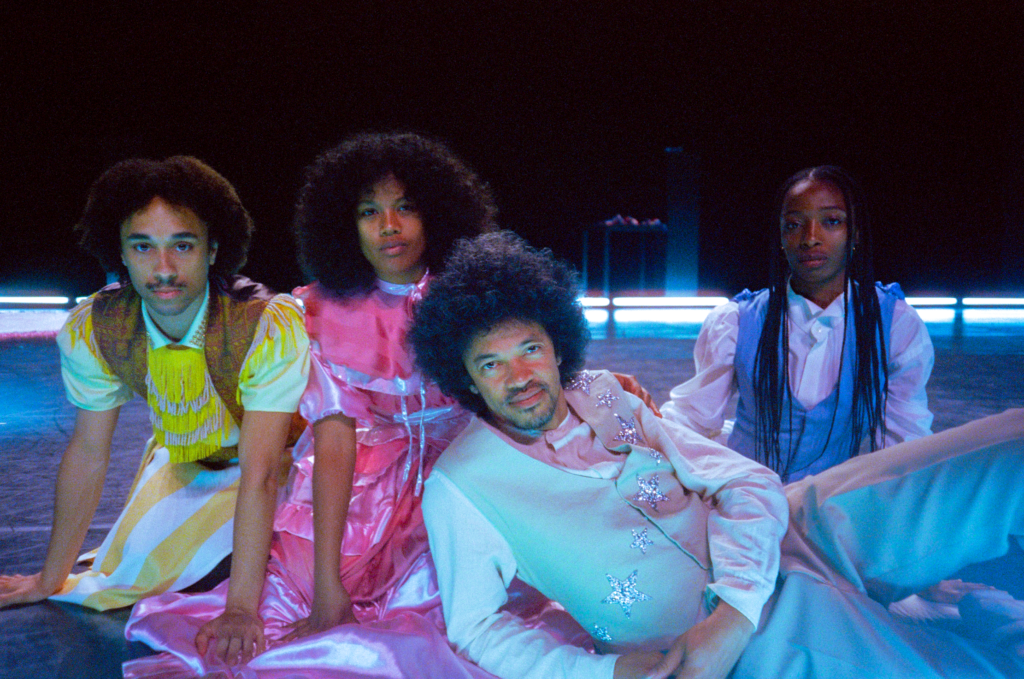
Fampitaha, fampita, fampitàna – three Malagasy words that mean comparison, transmission and rivalry. In a score of abstract and figurative gestures, dancer and choreographer Soa Ratsifandrihana makes use of her own experience of diaspora and her Madagascan origins to tell us the kind of story she would have liked to have heard or seen as a child. Blending radio, musical and choreographic storytelling, the show plays with orality and movement, reminding us that our bodies, just like our words and sounds, are bearers of stories. Ratsifandrihana – who came to attention as a dancer in Rosas’ new version of Fase – drew inspiration from the words and stories she picked up on a recent trip to Madagascar. Joined by guitarist Joël Rabesolo and performers Audrey Merilus and Stanley Ollivier, she travels towards a form of wandering, exploring how several influences can lead to an unheard-of explosion of cultures like creolisation. Just as the change in accentuation between ‘fampitaha’, ‘fampita’ and ‘fampitàna’ alters the word’s meaning, the dancers glide from one state to another, seemingly following a constantly changing movement – or perhaps a form of creolisation.