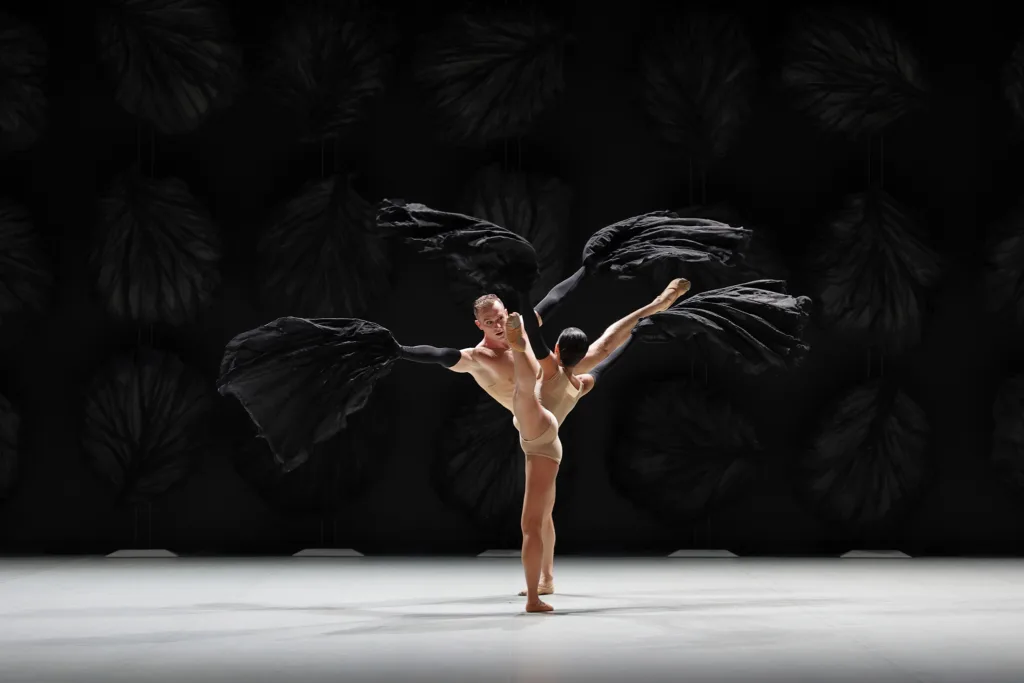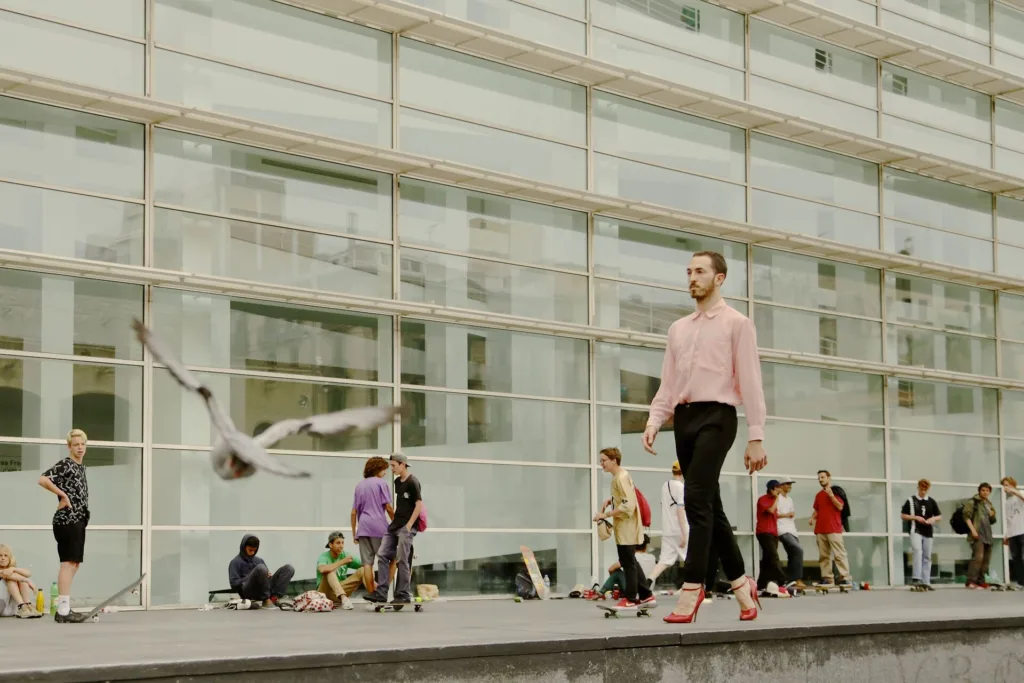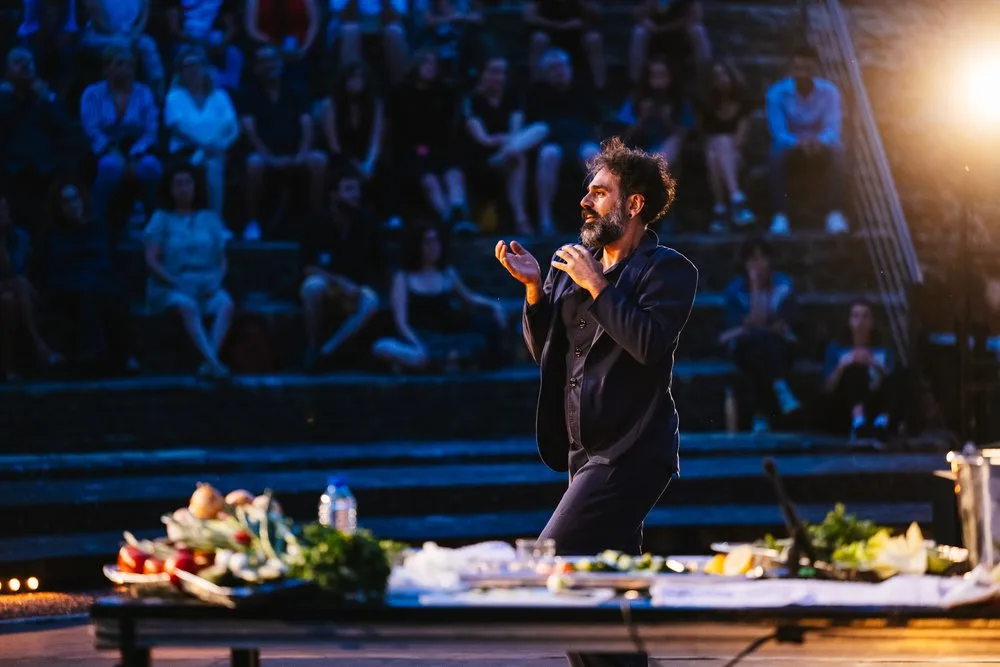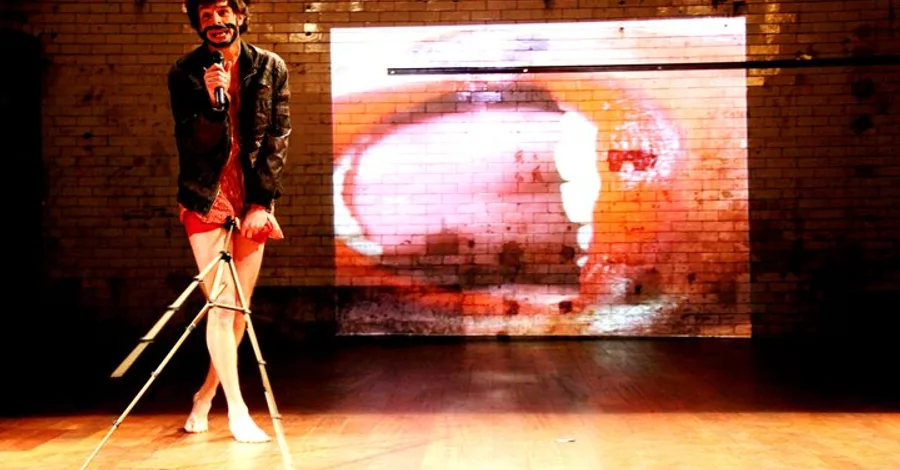
Spanish dancer and choreographer Joaquín Collado has much to anticipate with his new solo piece: he wants to examine dance not only physically, but also historically and theoretically. His research draws on iconic dance works, such as Mary Wigman’s Hexentanz (1929), Solo (1997) by William Forsythe or the ballet piece L’après-midi d’un faune (1912) by Vaslav Nijinsky. Joaquín Collado’s male and queer perspective as well as the written documentation of his research make this haunting solo a contemporary and dance-choreographic body-archive. Joaquín wants to know how to generate a corporeal presence that twists any conjecture about what it is, constantly evades categorization, and makes its dance a continuous blooming.
January 30th, 2025 The Arts Center, Abu Dhabi February 20th – 21st, 2025 Manège Fonck, Liège March 7th – 8th, 2025 Balkan Cinema, Belgrade April 17th, 2025 Congress Innsbruck, Innsbruck November 28th – 29th, 2025 Teatro della Tosse, Genoa 80 minutes
Beytna is a unique dance performance around the concept of sharing, where four choreographers and four musicians from Lebanon, Korea, Palestine, Belgium, and Togo come together over a banquet of food. Despite their diverse cultural backgrounds and artistic experiences, they reshape a communal and traditional family reunion into an artistic meeting of dance, music, and cooking.
Witness as they talk, drink, laugh, dance, and eat, transforming this simple gathering into an intricate, captivating performance. Beytna invites you into a world of compassion, and friendship. It is a simple invitation into the home of the other. An invitation to the artist’s profession and choreographic statement, as much as it is to the forms and situations of the past.
O amor natural goes beyond the binary codes of yes and no and explores consent in all its non-verbal richness: whispers, body temperature, breathing, gaze and speed of movement weave a web of intimacy. The concept of consent raises many questions about care practices, but also about sexual and artistic practices. How do we know and how do we communicate what we do and do not want? On what basis can we consent to a practice that is still foreign to us?
For people with disabilities, touch is often associated with a medical act, as if their bodies are objects to be manipulated and moved without regard to their physical and emotional needs, in a relationship that is necessarily devoid of any sensuality. O amor natural is about giving ourselves the chance to express the complexity of touch in our relationships, where we often only allow ourselves to conceive of touch in a medical or sexualised relationship.
In 2023, while researching medieval music, Kevin Malfait discovered an Occitan song, La marca de la pièra, whose poetic text diverged from typical medieval themes. The damaged manuscript’s melody was reconstructed using a similar 18th-century piece by Guillon. Inspired, Malfait collaborated with dancer Charles Pietri, who recognized the story from Corsican family traditions. Together, they created a performance exploring the connections between Occitan and Corsican cultural memory.
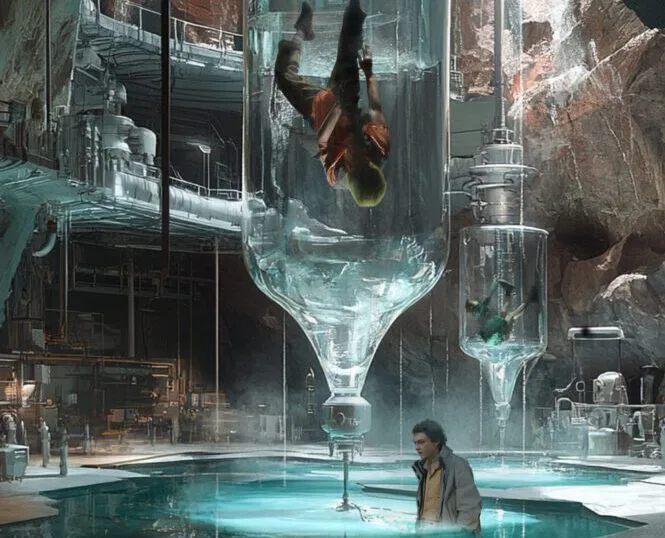
There is a world of children and a world of adults – and then there is the world in between: the world of puberty. It is an exciting, irritating, and ever-changing place where the laws of reason, gravity, and motivation no longer apply. This is where THE EXPERIMENT will take place.
Three scientists will test the force of gravity, the consequences of risks, and the social dynamics of clones to answer the ultimate question: Is reality truly real?
January 23rd – 24th, 2025 Théâtre Orléans, Orléans January 31st, 2025 Scène Nationale Aubusson, Aubusson February 4th, 2025 L’empreinte, Tulle February 7th – 12th, 2025 Théâtre de la Bastille, Paris March 28th – 29th, 2025 Points communs, Cergy April 1st – 2nd, 2025 La Coursive, La Rochelle April 8th, 2025 Scène nationale du Sud-Aquitain, Saint-Jean-de-Luz April 11th – 12th, 2025 TNC, Barcelona April 15th – 16th, 2025 Théâtre Auditorium de Poitiers, Poitiers April 18th, 2025 Le Moulin du Roc, Niort 40 minutes
What if you grew up in a war zone? How does that impact your identity?
“Can you still hear the bombs? I can hear them.”
What if you grew up in a war zone? How do you cope as a child when you are exposed to political conflict on a daily basis?
The choreographer and performer Samaa Wakim grew up in the occupied Palestinian territories. During this solo dance performance, she asks herself how these experiences impact her identity. Through movement and sound, she remembers her youth and the imaginary world she created in order to survive. Driven by her own sounds and live music by Samar Haddad King, she goes back and forth between fear and hope, between sounds that used to scare her and sounds that used to bring her comfort.
A physical and metaphorical race against time: Three performers navigate a world that values productivity above all else. The tyranny of time becomes a force of constraint and urgency, amplifying the stakes of the performers’ pursuit of autonomy in a system that demands efficiency without acknowledging diverse experiences. This piece delves into the complexities of marginalized bodies in a society that prioritizes output over well-being, questioning the cost of constant productivity and the possibility of reclaiming one’s self within its relentless march. As a compelling exploration of power, play and the merciless passage of time, the work confronts the intersection of neurodivergence, body dysmorphia and societal pressures.
January 22nd – 23rd, 2025 Opéra Berlioz / Le Corum, Montpellier March 7th – 8th, 2025 Berliner Festspiele, Berlin March 17th – 21st, 2025 Théâtre de la Ville, Paris May 3rd, 2025 Festspielhaus Bregenz, Bregenz 85 minutes
Freedom Sonata is a free, contemporary take on the classic musical sonata form, evolving through three distinct choreographic movements.
The soundtrack is a juxtaposition of two musical sources: Kanye West’s 2016 album The Life Of Pablo and L. V. Beethoven’s second movement from his last sonata #32. Played by Mitsuko Ushida and recorded in 2006.
‘Freedom Sonata’ is yet another chapter in a continuous study into the ways in which groups/individuals behave, function and strive to find a state of balance and fulfillment. It is a manner of looking at the way society organizes itself in different contexts and exploring possible alternative models.
‘Freedom’, the term and concept, is probably the most abused, misused and misunderstood word that exists. The truth is that nothing is easier than stripping people down from any sort of freedom, liberty or natural right. Choreography can serve as a space to examine how to solve the internal tension between the individual and the collective. When asked if my work is political, I answer that my work is not political, but the way in which I work, IS.
If I look at my work from an anthropological angle, as in a process of actively examining questions such as: models for groups organisation, governance modalities and political structures, economic models, resources management and so on, the way I would define it then would be something like:
A commitment, through a choreographic practice, to the idea that it can be possible to have a society based on principles of self organization, voluntary association and mutual aid.
Decentralizing the conventional hierarchies between choreographer and dancers, rethinking the distribution of power and responsibilities, defining what choreography/dance can change the established paradigms by placing individual freedom at the center of dance making, are the most valuable strategies through which dance can become a relevant force in pointing out societal anomalies and proposing alternatives.
January 20th – 21st, 2025 Théâtre de la Cité Internationale, Paris March 12th – 13th, 2025 Le Gymnase CDCN de Roubaix, Roubaix April 2nd – 3rd, 2025 CCAM, Vandoeuvre April 23rd – 24th, 2025 Pôle Sud CDCN Strasbourg, Strasbourg 75 minutes
As a true danced elegy, this piece questions lineage in the choreographic field through the prism of over fifteen years of collaboration with the German choreographer Raimund Hoghe, who passed away in 2021. Aiming to shine a light on how this generation of creators continues to influence us, Emmanuel Eggermont revisits fragments of pieces woven from moments suspended in time, in which love and death act in the background, articulating them with other personal materials in order to imagine new writings.
In About Love and Death, it is both the iconographic and musical palette of Raimund Hoghe and the living kinesthesia of the imagination of Emmanuel Eggermont that are expressed. From fantasy of a fantasized fauna to the comical elegance of a Gene Kelly dancing in the rain by way of the syncopated energy of a Josephine Baker, this danced medley is accompanied by new sequences that multiply evocations, leading up to the incarnation of the ghost of Raimund Hoghe himself.
The ramified writing of this elegy-toned collection reveals an entire panel of references offering to all audiences, particularly those experiencing it for the first time, a path to access this unique and necessary universe in the panorama of the history of dance.
Daniel Linehan created “Not About Everything” in 2007 in New York shortly before moving to Brussels. It meant his international breakthrough and he has continued to perform his solo to this day.
He reflects on the creation and it’s meaning from today’s perspective:
I made “Not About Everything” as a young artist in a world with an abundance of information, in search of an answer to the often-repeated question “What is your work about?”. Any attempt to define this felt like a limitation. The pieces I had created up to that point were about a million things, sometimes in a span of ten minutes. What do I want to talk about?
My answer is a dance. A dance that starts with words. The cadence of sentences triggers a loop of circular movements. And a dance that asks questions as well. What is the value of a piece and what impact does it have on me, the audience and the world outside the theater? The answers work their way through my body and find expression in movement and sound. In all my creations, sound plays a crucial role. The vocal cords are as important as any other muscle and dance continues into words that in turn evoke new movements.
In the solo, I come to an essence by clearing out layers of text and movement, tangible but unspoken.