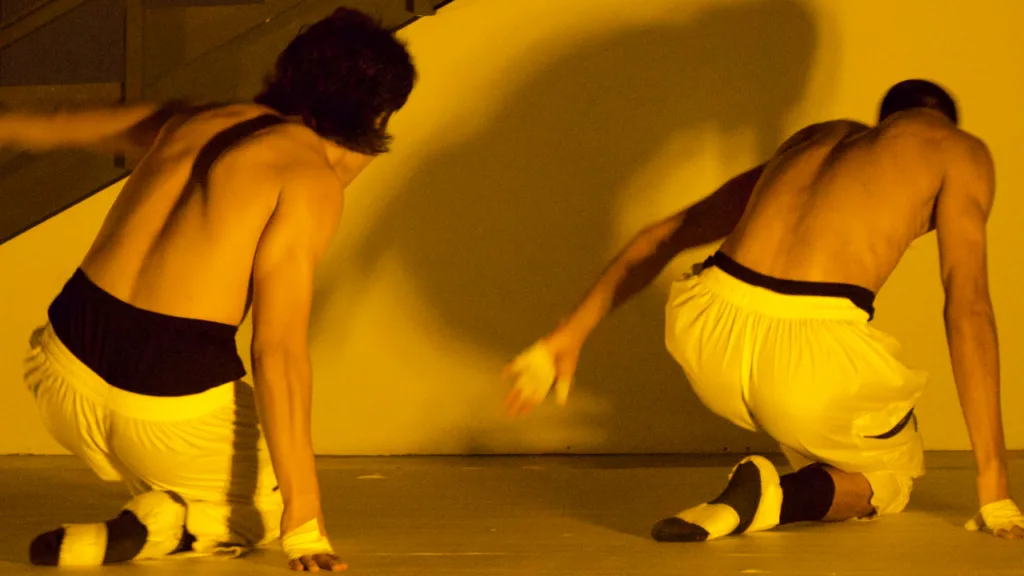
In Sahara, Claudia Castellucci’s choreographic and philosophical research grapples with the dimension of the desert, where the extreme lack of materials and relationships pushes dance to consider only what one has: oneself, as the only—first and last—instrument. The empty desert forces a radical visual relationship with one’s shadow, which, perpetually projected, cannot be ignored. Barely tolerated, it forces one to seek the company of the only things that can be found in total solitude: the products of the mind. These are the subjects of the dance, which asserts its very essence in Sahara.
Choreographer Lucinda Childs is the queen of minimal dance. She will be 85 years old in 2025, and Introdans is celebrating this with the focus programme ICON, a tribute to the ‘grand old lady’ of American dance. This evening the audience will experience a (time) journey that starts with Interior Drama from 1977, new for the Dutch audience, past the pieces Kilar, Petricor and Concerto that Introdans has danced before, and ends with a world premiere of her latest work: Notes of Longing.
Childs’ movement idiom is absolutely unique: taking an abstract, almost mathematical approach she uses relatively simple ballet and athletic movements to create amazingly complex masterpieces. The bond between Childs and Introdans can also be called unique, there is no company in the world that dances so much of her work. Introdans has a rich oeuvre of existing and new work by Lucinda Childs. With ICON it underlines this special bond.
The choreographies Kilar, Petricor and Concerto are accompanied live in a number of theatres by the National Youth Orchestra led by Jurjen Hempel. Notes of Longing will then also be accompanied live by composer / pianist Matteo Myderwyk.
Ridden presents moments of “recovery and discovery” in the face of natural disasters. In 2018, a massive tsunami struck Sulawesi, the home of Leu Wijee. When everything seemed to stand still, Leu found an intimate dialogue with himself amidst those fragile moments. He channeled these emotions into creating a collaborative piece with Mio Ishida, an artist from another country within the Pacific Ring of Fire.
The artists explored how people respond to loss after a disaster. Through a process they define as “Between Disaster and Dance,” they gathered traces from both the bodies and physical landscapes and developed simple yet relentless choreography. Five performers, who act as dancers and musicians, bring a sense of hypnotic and ritualistic-like moments—familiar, yet strange imagery.
The analysis of myths has always been approached from a patriarchal, xenophobic perspective, rife with slut-shaming, perpetuating the illusion of a single possible interpretation for each story–glorifying the ‘good’ and ostracizing the ‘bad.’ It is urgent for me to question the myth of Medusa and the prevailing injustice toward this mistreated figure, who was ultimately abandoned by society, strikes me profoundly today. As Abir Alsahlani said, “with the current political climate of blatant hypocrisy and humanity failing again and again, it seems necessary to retell the stories that have been swept under the rug of conservatism, neutrality, silence, and complicity.”
This dance was supposed to be a trio. After the death of my trans sister and best friend, Teresa Ves Liberta, this piece is conceived as a gift for her and for all the magic and strength she brought into being.” — Oscar M. Damianaki
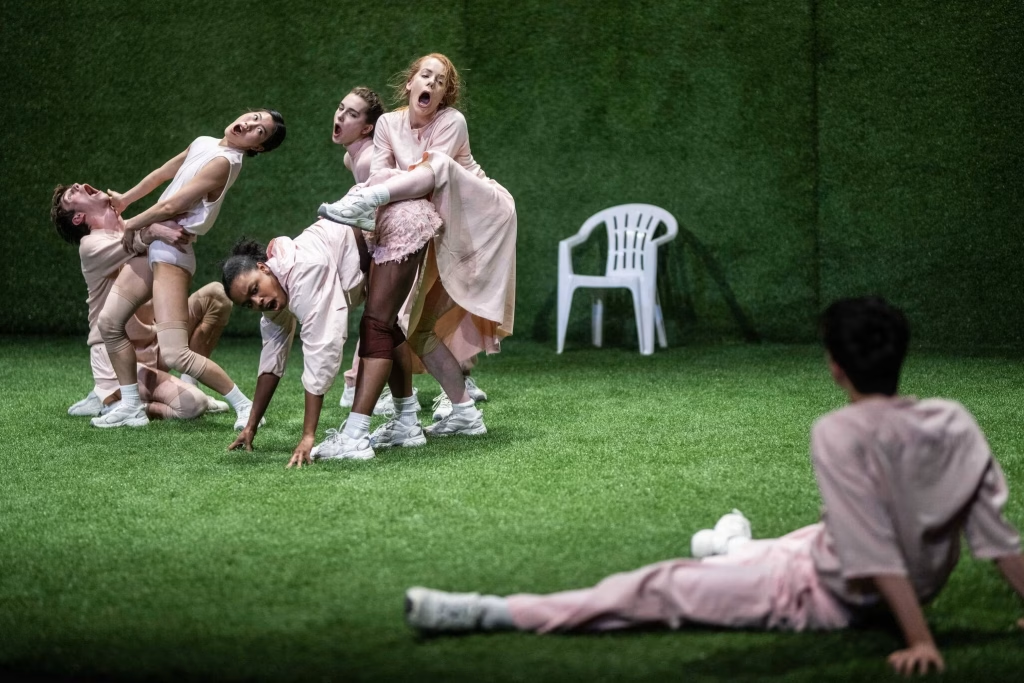
In the piece GOATS by French/Luxembourgian duo Sarah Baltzinger + Isaiah Wilson, the performers are immersed in a hallucinatory world, in between pastoral satire and bestiary dream. GOATS unfolds in an absurd, Kafkaesque universe, where Gilles Deleuze’s philosophy of «becoming-animal» serves as a lens to explore contemporary alienation. On stage, the performers embody hybrid beings—half-human, half-goat—reflecting a world in which they can no longer find their place. Their only escape lies in metamorphosis, a shift toward animality that unveils humanity’s desperate search for relief from the relentless cruelty of its surroundings.
This journey takes place within a scenography that blurs the line between reality and fantasy. A surreal landscape of grass dominates the stage, evoking a pastoral kingdom both idyllic and oppressive. It is a space suspended between the sacred and the playful, where the rules of ritual and the discipline of games intersect. Viewers are left to wonder: is this a prison, a human zoo, a stadium, or a fantastical world ? This ambiguity underscores the disciplinary nature of the space, which confines the performers within its surreal boundaries while shaping their identities and actions.
March 7th, 2025 Festival ARTDANTHE, Vanves April 2nd – 4th, 2025 TROIS C-L, Luxembourg May 25th, 2025 Abbaye de Royaumont, Asnières-sur-Oise May 30th – June 1st, 2025 Villa Vauban, Luxembourg July 5th – 24th, 2025 Festival d’Avignon, Avignon Duration: unknown
Universally hailed as the enfant terrible of contemporary folk dance, Mr Chevalier is the Ballet National Folklorique du Luxembourg’s flamboyant new artistic director – and together with his co-director Simone Mousset he will come to you for the first time with an exclusive solo tour! Renowned in dance industry for his expertise, bold artistic vision, and magnetic stage presence, Mr Chevalier will tour the world and pay tribute to all the venues that have contributed to the success of the Ballet National Folklorique du Luxembourg in the past.
The Great Chevalier Tour coincides with the 50 year anniversary of the company’s most famous ballet, Josiane, the Country Girl, and on his various appearances, Mr Chevalier will perform among others the iconic Pigeon Dance, an emblematic classic from Josiane, the Country Girl. An unsurpassed expert in the field, Mr Chevalier will respond to the particular histories that link each venue with the Ballet National Folklorique du Luxembourg’s past, and audiences can expect to discover his unique blend of charisma and virtuosity as they are invited into these shared histories and the Ballet National Folklorique du Luxembourg’s rich cultural heritage.
Crowd, one of the most explosive shows by Gisèle Vienne, is the representation of a ritual: that of the party, a collective practice pertaining to all eras and societies. In the hallucinatory simultaneity of the lights, shadows, sounds and moving bodies of a rave party, the artist outlines a series of fascinating and deeply human portraits, focusing on the emotional experience—rather than the actual experience—of time. Gisèle Vienne returns to FOG with Etude 6, a performance that acts as a sort of negative of Crowd, sharing the experience of two characters marked by a lack and a vital need for the crowd. All of Gisèle Vienne’s works are political, not only through their artistic and philosophical stakes but also through formal research, questioning culturally constructed perceptions and the possible shifts in those perceptions. This work offers a direct and visceral response to immediate and profound pain—the kind of pain experienced by bodies constrained and restricted by political systems of domination, in which something that deeply concerns us emerges.
The Jin Xing Dance Theatre was formed in the heart of communist China in 1999 by its founder Jin Xing. At Paris’s Théâtre des Champs-Elysées the company will present four choreographic creations by three choreographers of different origins.
Sacre is revisited version of Emanuel Gat’s 2004 creation. It takes apart the mechanics of Cuban salsa dancing and creates a complex and dramaturgically charged choreographic score. A free spirited reading of Stravinsky’s masterpiece, Sac offers no notions of sacrifice, but a multitude of options for action.
Echo is Moya Michael’s 2013 creation for 7 female dancers with sound arrangement by Anyal Zhang. The focal point of this piece is a group of women, occupying space. Each woman has an individual story intertwining with the group, yet each woman has her own voice. This is not a form of isolation. Recognition is placed on the female gaze and specifically on how change can be experienced through each of their lives. This perspective gives them a greater sense of how they relate to other women and to society as a whole. Their stories echo and their lives reflect similar struggles. They can empower themselves by being true to who they are and by uniting with each other as group. This is a shortened version of the original work.
Cage Birds’ energetic and physically demanding choreography for 12 dancers to Christian Meyer’s hypnotic music. Kuggeleyn uses his trade mark TransDance technique gradually enfold the inner dynamic of the group of performers. Like caged birds the dancers move in their cramped confines. With his creation, Kuggeleyn provides an ironical metaphor of modern life as well as an impressive dance performance.
Wild Flower by Arthur Kuggeleyn
Everyone has a fierce and unique wild flower, which can break free from all kinds of shackles, stand out among the dull, and be graceful within constraints. Known for his emotionally charged psychedelic style, Dutch choreographer Arthur Kuggeleyn created Wild Flower for the company. In it, dancers interpret wild flowers through marathon-esque non-stop dancing and movement, triggering off an explosion of long held emotions.
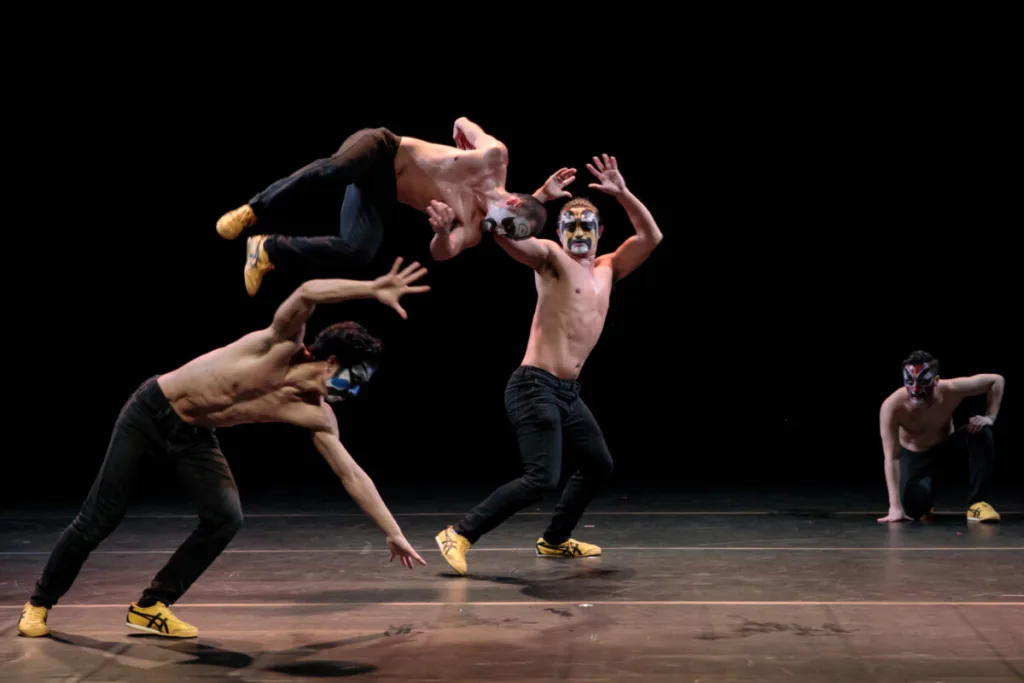
No Dragon No Lion redefining the martial arts and performing arts on stage by integrating Cantonese opera with kung fu, acrobatics, parkour, tricking, capoeira and dance. Furthermore, it transforms the Lion Dance to a new form of performance by replacing the traditional drum music with live beatboxing. Also, by fusing different comedic effects, No Dragon No Lion is an energetic and entertaining contemporary dance and circus show yet with rich cultural overtones.
In his artistic practice, Alex Baczyński-Jenkins explores affects, queer sensuality, the collective and the suspension of time. He comes back to Arsenic with a new group performance dedicated to the finitude. Whether it’s through a grand finale, the erotic erasing of the limits, or through ecstatic surrender. The final result is an intense dance looking for an expression of the intensities of the end, of the endings. In the end, the result is almost tactile, raw and minimal.
The artist, co-founder and member of the queer feminist collective Kem, laureate to the prestigious Frieze Artist Award in 2018, offers here, once more, a piece of rare and radical beauty.