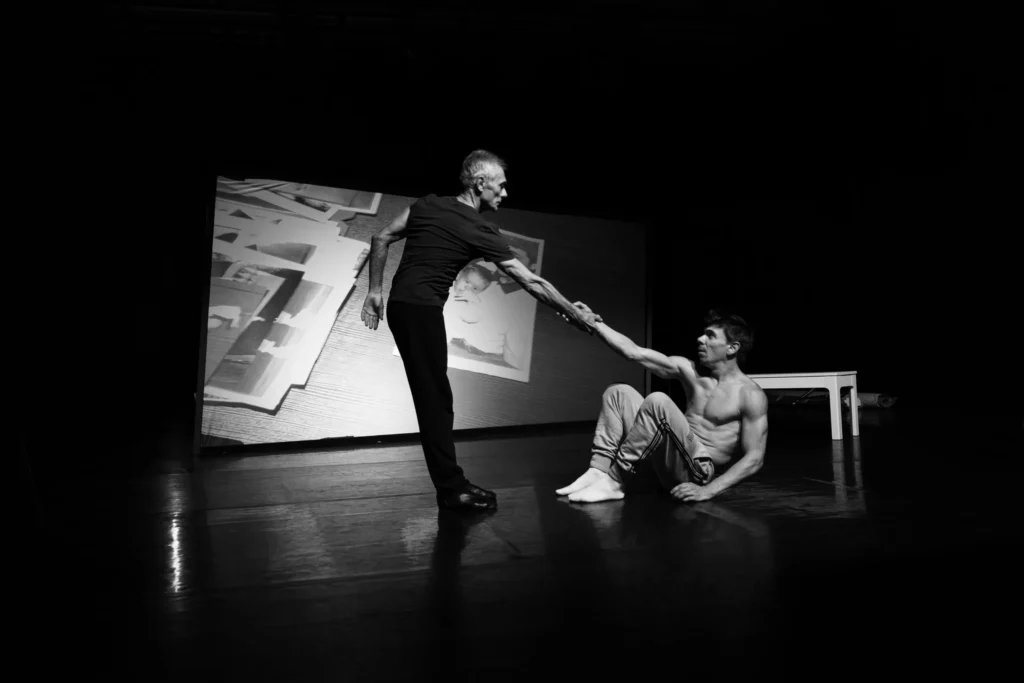
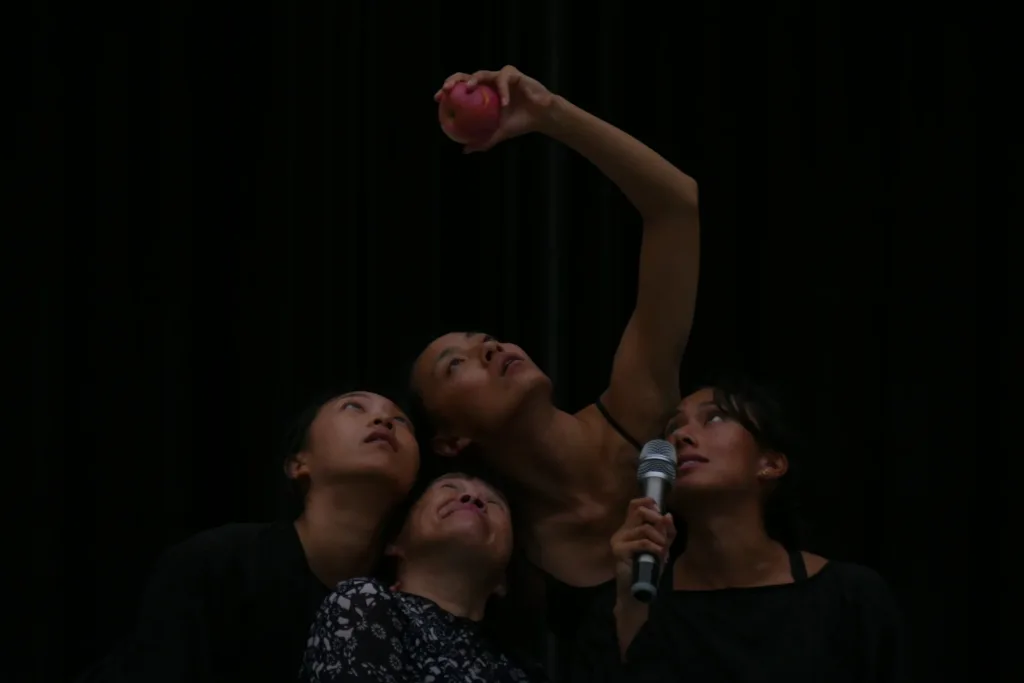
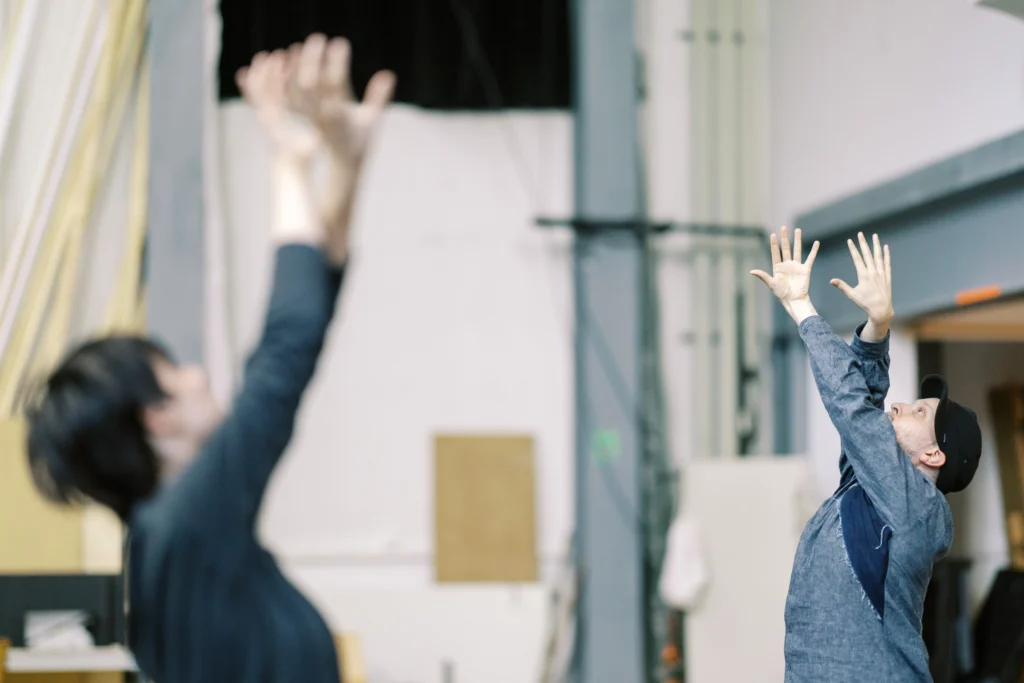
Their names are Francis and Antoine Pedros. They are father and son, and both professional dancers. Francis was soloist in the Ballet Royal de Wallonie, which later became Charleroi Danse, Antoine is a dancer and choreographer for his own company.
With this duet, Maria Clara explores the father-son relationship through the language of dance which they have in common, but also through words, memories and anecdotes…
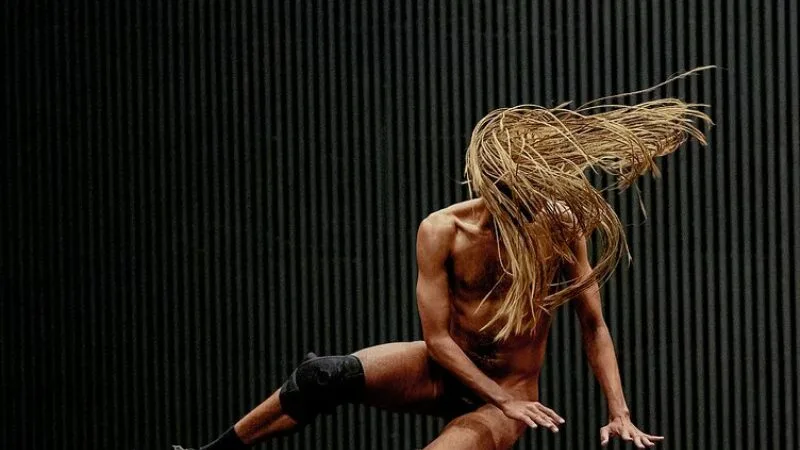
There are hints of dancehall dutty wine whirls, or sexy pelvis swaying. The movements are always ambivalent: they range between vulnerable, violent and ecstatic, yet become mechanical and ‘empty’ through numerous repetitions.
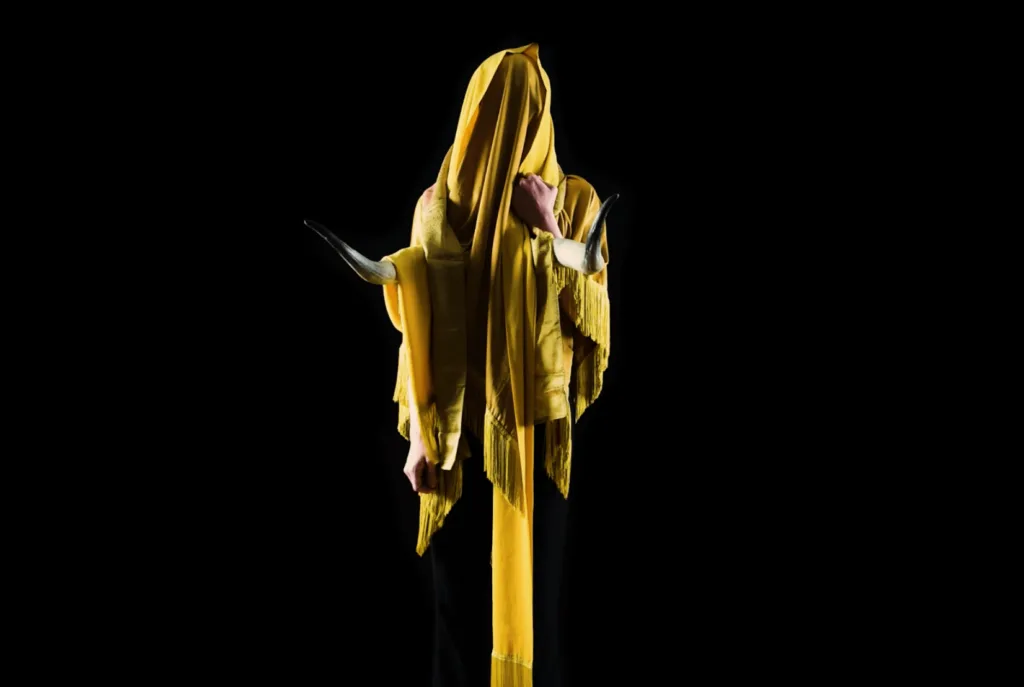
Batty Bwoyis a solo performance in collaboration with Karoline Bakken Lund, Veronica Bruce, Jassem Hindi and Ring van Mobius.
Through a reappropriation of the Jamaican term “ Batty Bwoy” (litteraly, butt boy), slang for a queer person, the work twists and turns myths to invoke demonic sensitivities and charming cruelties, unfolding vulnerable possibilities in an interplay of consciousness and naivety. The horror and joy of Batty Bwoy, inherent to queer blackness, is unmasked.
Scrutinizing the absurdity of a queer monstrosity, Batty Bwoy articulates the porosity of bodies and languages, their mouths swallowing and regurgitating the corporal fictions projected onto their skins.
Batty Bwoy attacks and embraces sedimented narratives around the fear of the queer body as a perverse and deviant figure. The expression “Batty Bwoy” is used to evoke an ambivalent being that exists in the threshold of the precarious body, liberated power, joy and batty energy!
The work has found inspiration in mythologies, disgusting stereotypes, feelings and fantasies of the queer body and identities, homophobic dancehall lyrics, 70s Giallo films from Italy, resilient “gully queens” and queer voices in Norway and Jamaica that have visited and taken part of the process.
November 15th – 16th, 2024 Les Halles de Schaerbeek, Brussels November 22nd – 24th, 2024 Dansens Hus, Olso December 3rd, 2024 PLT Theater, Heerlen December 6th – 7th, 2024 Teatro Municipal do Porto, Porto December 10th – 11th, 2024 Les Théâtres de la Ville de Luxembourg, Luxembourg 60 minutes
4/4 is Chunky Move’s blueprint for choreographic precision, physical endurance, minimalist design and rugged street aesthetics.
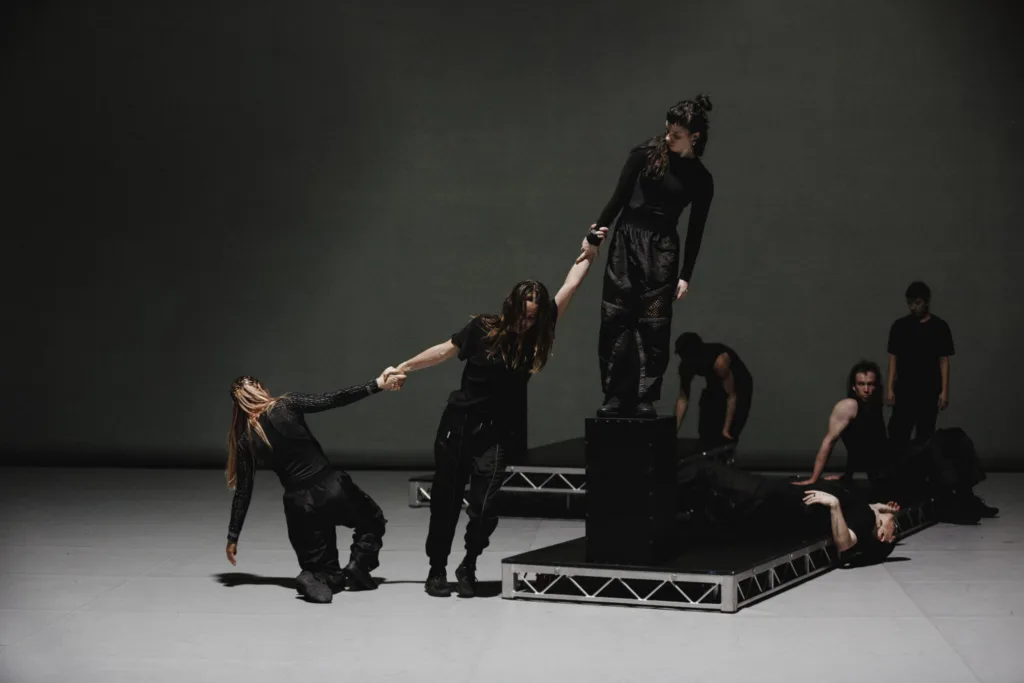
Eight dancers perform a stark symphony of mesmerising movement against the backdrop of minimalist design. As episode after episode builds upon the last, quartets and duets converge and diverge in ever more hypnotic configurations.
Described by audiences as meticulous, mesmerising and exhilarating, and collecting 5- and 4-star reviews and a Green Room award and nomination, 4/4 is a stunning and unrelenting display of Chunky Move Artistic Director Antony Hamilton’s distinctive choreographic language and methodology.
Ten Thousand Tons of Moonlight is a compelling dance-theatre production that draws inspiration from the thought-provoking poems of Yu Xiuhua, a female celebrated contemporary Chinese poet. The production brings to life Yu Xiuhua’s reflections and questions on love, beauty, disability, and the societal expectations placed on women.
Conceived and directed by Farooq Chaudhry, Ten Thousand Tons of Moonlight, merges the languages of poetry, dance and visual design to explore the dualities and contradictions that inhabit Yu Xiuhua and all of us. The performance raises questions about the role of personal struggles in finding our authenticity. It asks whether stepping out of the shadows and embracing our true selves is the key to finding liberation, or if these shadows hold a deeper meaning? Could these poems, serve as a doorway to an alternate reality where our essence can flourish and our souls can find freedom?
A piece that invites us to reflect and review the speed of our era, installed in our bodies and fragmenting our attention. Javier Martín invokes the concept of ancestral rituals of “crossing the threshold”, involving the body in a social dance. In the words of the artist: “The famous ‘Guardian of the Threshold’ archetype refers to those figures that take on the forms of our most intimate fears: they guard the threshold, not to deny us entry, but to encourage us to explore the propitious labyrinth that facilitates transformation and, therefore, passage.”
Javier Martín, a choreographer with a scientific background and passion for philosophy, is developing an epistemological and critical research project about the art of movement. He takes a transdisciplinary approach to choreographic creation and dance, drawing on writing, performative conferences, research groups and creative laboratory and tool development. Since starting out in 2005, he has created and showcased more than 30 productions in Spain, France, Russia, Portugal, Ukraine, Mexico, Colombia, Guatemala and Uruguay, with fifteen stage shows and an equal number of site-specific projects and special collaborations.
November 13th – 19th, 2024 Grand Théâtre de Genève, Geneva January 18th – 19th, 2025 Staatenhaus, Cologne January 24th, 2025 Festspielhaus St. Pölten, St. Pölten March 30th – April 6th, 2025 Théâtre du Châtelet, Paris October 2nd – 4th, 2025 Danse Danse, Montreal December 12th – 17th, 2025 De Singel, Antwerp Duration: 90 minutes
In Arabic, the word Ihsane represents an ideal of goodness, kindness and benevolence. In Islam, it refers to a form of communion with the universe. With Ihsane, Sidi Larbi Cherkaoui continues a diptych begun within his Eastman company with Vlaemsch (chez moi), in 2022. While Vlaemsch was dedicated to his mother and his Flemish roots, Ihsane explores his relationship with his father, who left Morocco for Flanders, emigrating but always retaining – despite leaving – an unconditional love for his home country. Sidi Larbi Cherkaoui was still a teenager when his father died. Thirty years later, he searched for him in vain in a Tangier cemetery too full of graves. He continues to search for him through this creation bringing together dancers from the Ballet du Grand Théâtre de Genève and Eastman.
But in Belgium, Ihsane is also associated with a racist and homophobic crime that took place in Liège in 2012: a young homosexual man of 32, of Moroccan origin, beaten to death outside a nightclub. As someone who himself identifies as an artist, a queer and an Arab, Sidi Larbi Cherkaoui identifies with and pays tribute to him through this production which revisits his family story. Ihsane is a journey towards the quest for inner peace, and the attempt to transcend conflict, abandonment and forgetting. Sidi Larbi Cherkaoui dances the questions that obsess him: what do we have left when our place slips away and fades? How can multiple identities coexist in the same body?
As ever, the choreographer has assembled a unique artistic team, reflecting the effervescence and artistic vitality of this region of the world to which Sidi Larbi Cherkaoui is linked through his ancestors. Tunisian musician and viola d’amore virtuoso, Jasser Haj Youssef, will compose the music and perform it onstage with Moroccan singer Mohammed el Arabi Serghini and Lebanese singer Fadia Tomb El-Hage. Stage design will be from visual artist Amine Amharech, who creates sensory and sensitive spaces into which Moroccan influences are often melded, while costumes are by fashion designer Amine Bendriouich, who elevates traditional forms of Berber clothing beyond norms and gender.
With Ihsane, Sidi Larbi Cherkaoui watches the world change in a never-ending cycle of destruction and rebirth. He is wary of cultures when they imprison and separate individuals. He prefers geography in the making, ever-changing landscapes, and the shared space where we coexist. In this space, he reveals the invisible threads that connect us to each other.
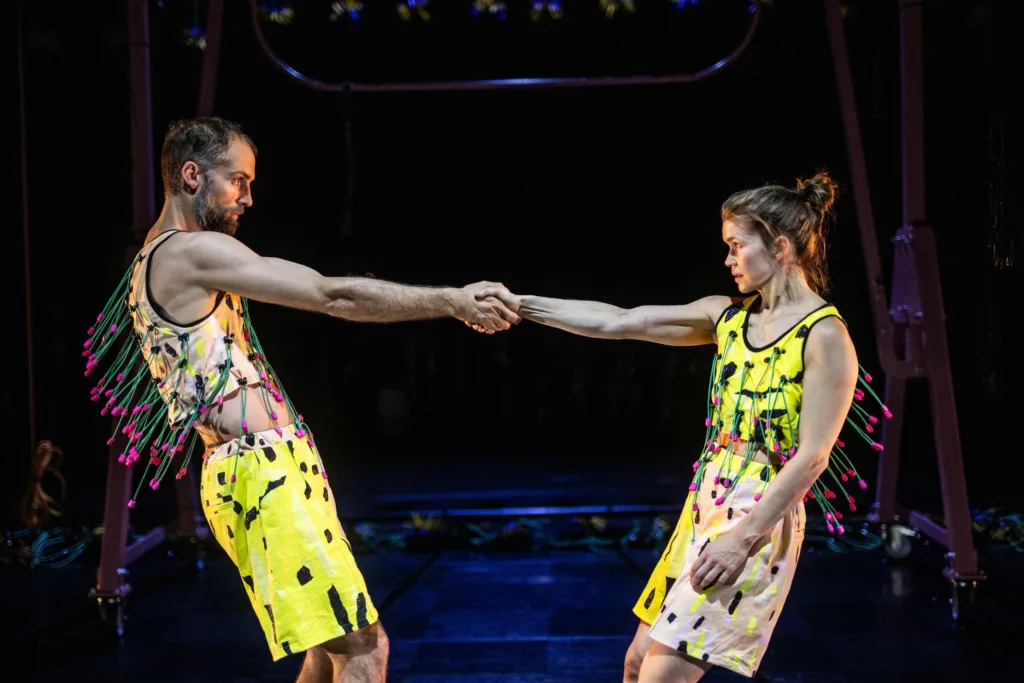
In every_body, choreographer Alexander Vantournhout, alongside collaborator Emmi Väisänen, delves into everyday movements. They elevate simple actions like handshakes and walking into a complex canvas of bodily dynamics. The duo crafts a tapestry of choreography, turning even the subtlest of movements into something remarkable.
The performance is further enriched by the sonic landscape created by composer and guitarist Geoffrey Burton. Fashion designer and scenographer Tom Van der Borght designs both the costumes and the surreal setting where every_body takes place.
Over the last decade, Alexander Vantournhout has built a diverse oeuvre, from ensemble pieces to solos. Every_body (2024) is his fourth duet, following projects like Through the Grapevine (2020). The new creation marks his next step to dissect and reinterpret everyday movements, redefining the limits of human physical expression.
November 8th – 10th, 2024 National Performing Arts Center, Taipei November 15th – 16th, 2024 Rohm Theatre Kyoto, Kyoto November 20th, 2024 The Museum of Art Kochi, Kochi December 10th, 2024 Theater im Pfalzbau, Ludwigshafen December 18th – 19th, 2024 Auditorio de Tenerife, Santa Cruz de Tenerife January 25th, 2025 Teatro Municipal da Covilhã, Covilhã February 1st – 2nd, 2025 Sadler’s Well, London February 7th – 9th, 2025 Perth Festival, Perth February 26th – 27th, 2025 Le Quartz, Brest March 4th, 2025 Les Quinconces et L’Espal, Le Mans March 6th – 7th, 2025 CCN de Caen, Caen March 10th – 11th, 2025 Théâtre de Cornouaille, Quimper March 14th, 2025 Cndc Angers, Angers March 28th – 29th, 2025 Tanzmainz Festival, Mainz April 2nd – 4th, 2025 La Comédie de Clermont, Clermont-Ferrand April 8th, 2025 Théâtre de Nîmes, Nîmes April 15th, 2025 Espaces Pluriels, Pau April 30th – May 3rd, 2025 Danse Danse, Montreal May 16th, 2025 Theatro Circo, Braga July 8th – 9th, 2025 Colours International Dance Festival, Stuttgart 75 minutes
Collective identities are sources of belonging and inclusion but when they become mainstream, they can turn the other way around. I can recognise this issue in dance.
In CARCAÇA, ten dancers including Marco da Silva Ferreira and two musicians form an unconventional and joyful corps de ballet. The dancers perform intricate footwork merging folk dances with contemporary urban dance styles from groups such as LGBTQIA+ and communities from ex-colonies. In this choreography, Marco da Silva Ferreira uses dance to investigate communities, the construction of collective identity, memory and cultural crystallization. In other words: what if folk dances had not crystallized, had continued to redefine themselves and had incorporated the present at every moment?
The cast explores their collective identity in a physical, intuitive and unpretentious flow of the body, dance and cultural construction. They start from familiar footwork: clubbing, balls, cypher battles and the studio; they use the physical vocabulary of the contemporary, social, urban context as a lexicon of identity (house, kuduro, Top Rock, hardStyle, etc.). Through a slow construction process they connect these styles with the heritage and memory of dances from the past. These folk dances have remained stagnant without integrating new definitions of bodies, groups and communities, which were considered inferior. For these groups it was necessary to break with the authoritarian, totalitarian and paternalistic past.
In CARCAÇA an exercise is proposed that integrates the past and the present. The performance makes you think: How do you decide what to forget and what to remember? What is the role of individual identities in the construction of a community? What is the driving force of an identity? What world does the individual and collective body traverse? Or, better put, what bodies traverse the world?
Using Gilbert and George’s The Ten Commandments as a narrative backdrop, Thierry Smits revisits the gay aesthetic underpinning his work: Genet and Fassbinder, Pierre et Gilles, Francis Bacon, Sylvester, and Brokeback Mountain.
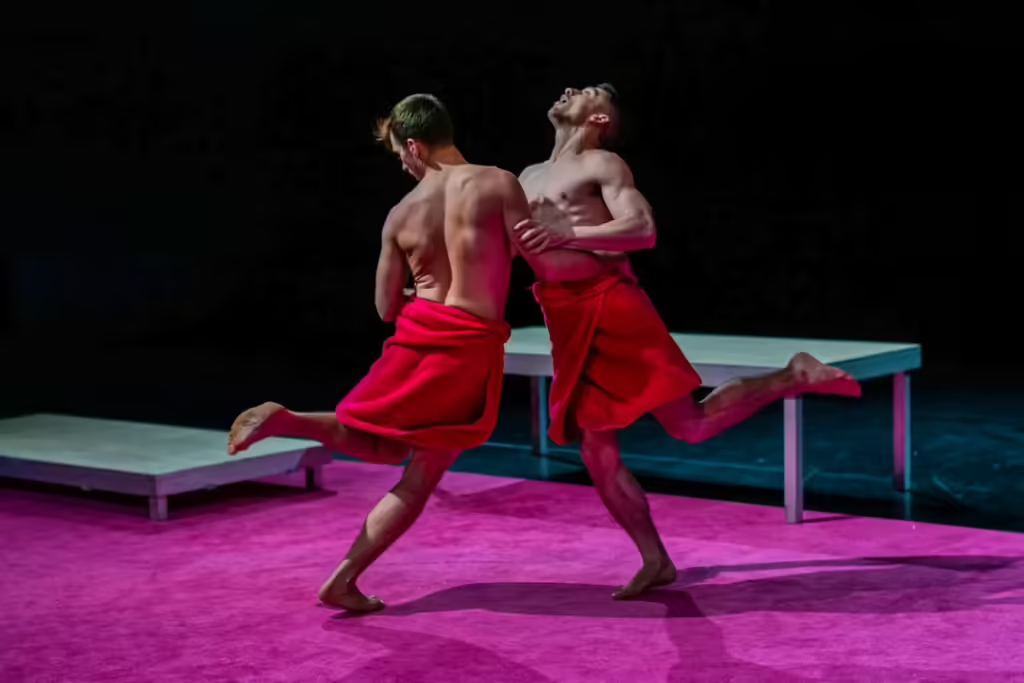
Set in a cabaret with a giant pink carpet, two dancers clash with humour and lightness as they reinterpret the iconic expressions of the LGTBQIA+ movement. From disco to country to ambient, this choreographic celebration is as wild as it is overly sexualised, as chromatic as psychedelic. From one scene to the next, the dancing takes us back to the world of camp.
Dynamically and insubordinately, it reminds us of the sources of a gaytitude that exalts our imaginations today.
November 6th, 2024 Theater De Veste, Delft November 8th, 2024 Stadsschouwburg Haarlem, Haarlem November 9th, 2024 Korzo, The Hague November 10th, 2024 Lux, Nijmegen November 11th, 2024 Internationaal Theater Amsterdam, Amsterdam 60 minutes
A powerful dance creation that prompts questions about new social hierarchies and interpersonal relationships in the virtual world.
Gli Stati Generali
In We, Us and Other Games, Jocić reflects on the ongoing digitalization of the human experience. A father searches for his daughter in a digital world called “The Living Project”, gradually losing his grip on reality. The performance, presented by an ensemble of eight dancers from the renowned Spellbound Contemporary Ballet of Rome, takes you on a hallucinatory odyssey through the digital subconscious, encountering androgynous insect armies, secret societies, masked parties, and a choir of children performing an ominous ritual dance.